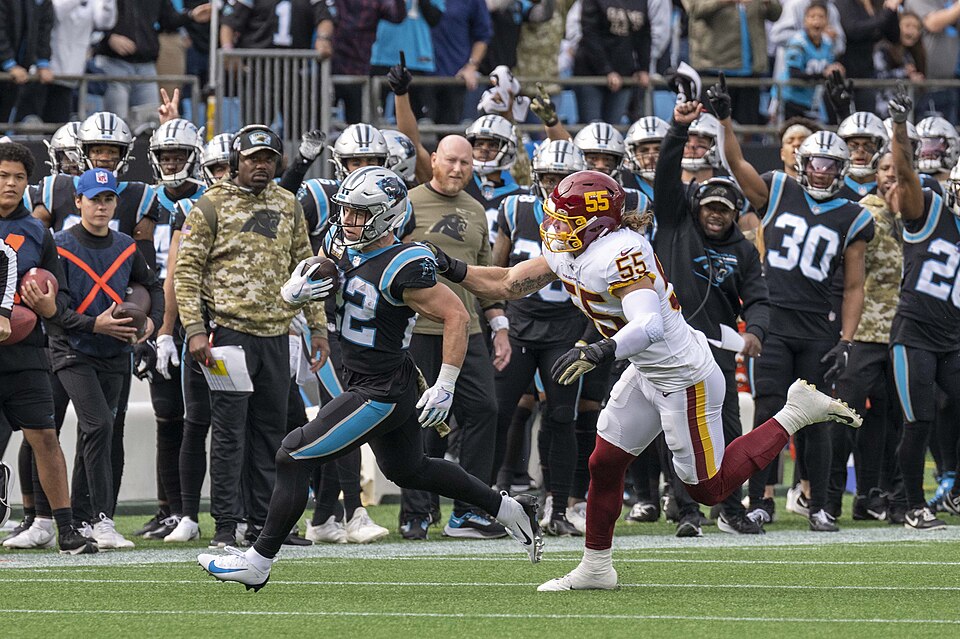
Jonathon Brooks is going to be one of those April names people want to feel smart about.
Carolina threw at a 59.7 percent clip last season, but once the Panthers got close they still ran on 39.1 percent of their red-zone snaps.
He dropped from 9.3 carries per game in the earlier tracked window to 5.0 late in the sample, and the role-trend file flags falling.
He is a usable RB3 or flex bet, not a backfield hammer.
I get it. Young back, easy comeback pitch, clean depth-chart fantasy on paper. If you say the name fast enough, it sounds like Carolina already handed him the backfield.
I do not think they have.
The sharper Panthers draft rule right now is a lot less sexy. Draft the job, not the comeback trailer. And in Carolina, the back who still has the real job on the page is Chuba Hubbard.
That does not mean Brooks is irrelevant. It means the market is trying to skip the part where a player actually has to take the work. Carolina's live FFN files still show Hubbard as the only Panthers back with a current fantasy footprint, while Brooks stays in the stash bucket until the role turns into something more than a spring guess.
Chuba Hubbard still owns the boring part of the job, and that is why he owns the better draft case
What worked for Hubbard last year was not mystery upside. It was that Carolina actually used him in a role that matters for fantasy before the room starts dreaming about what comes next.
He is still the only Carolina back with a live role sample in FFN's player-trend file, and he is still the only Panthers runner showing up in the current enriched rankings. In PPR, Hubbard sits RB28 and No. 84 overall. Brooks is on the roster file, but he does not show up in the current rankings or the live role-trend board yet. That gap matters, because it tells you which back has usable football evidence and which one is still being drafted off possibility.
The team context pushes the same way. Carolina threw at a 59.7 percent clip last season, but once the Panthers got close they still ran on 39.1 percent of their red-zone snaps. That is not an offense promising easy rushing efficiency. It is an offense still giving the lead back chances to matter if he keeps the trusted work.
Now the warning label. Hubbard's late-season carry trend cooled off. He dropped from 9.3 carries per game in the earlier tracked window to 5.0 late in the sample, and the role-trend file flags falling carries. That is the reason to stay alert. It is not the reason to pretend Brooks has already passed him.
Draft action: take Hubbard as the first Carolina running back if you want exposure here, but do it with the right expectation. He is a usable RB3 or flex bet, not a backfield hammer. Failure case: if Brooks gets a real summer push and the Panthers start shifting the valuable touches, Hubbard is the first player whose weekly comfort evaporates.
If you want to bet on Carolina improving, the cleaner bet is the passing game, and it starts with Tetairoa McMillan
The easiest mistake in this offense is assuming Carolina growth has to show up through the backfield. I think the cleaner version runs through Bryce Young's volume and Tetairoa McMillan's role.
What worked last year was that Carolina at least started showing you who the passing game wanted to feature. Bryce Young's passing volume rose late in the year, and McMillan's role sharpened at the same time. Over that closing three-game sample, he climbed to a 23.8 percent target share and a 64.9 percent air-yards share. That is not random receiver noise. That is a quarterback and receiver starting to agree on where the aggressive throws live.
What changed now is not a full offensive reset. Dave Canales is still the head coach. Brad Idzik is still coordinating the offense. That matters because this is not some brand-new system asking you to guess what it wants. The Panthers are still building out of the same structure, and the same structure already started pointing targets toward McMillan while Young's volume ticked up.
That is also why Bryce Young works better as a stack piece than a solo quarterback bet. FFN still has Bryce Young down at QB22 in PPR and No. 140 overall, which tells you the offense is not trusted enough to carry him by himself. Tetairoa McMillan is different. Tetairoa McMillan is already WR11 and No. 25 overall in PPR because the downfield target funnel is easier to buy than the quarterback's weekly floor.
Draft action: start your Carolina growth bet with McMillan, then decide whether Young is worth adding as a patient QB2 stack. Failure case: the Panthers still posted negative passing EPA last year, so better volume does not automatically mean cleaner weekly scoring.
Jalen Coker is the cheaper swing, and Xavier Legette is the name I still do not want to force
What worked for Panthers receiver Jalen Coker last year was simple. He kept earning more field time. His snap rate climbed from 68.7 percent in the earlier tracked window to 81.7 percent late in the sample, and his latest week closed at a 92 percent snap share with a 23.3 percent target share. Even when the target-share trend cooled a bit over the broader sample, the staying-on-the-field part remained real. That matters because late-round receivers do not need to own the offense right away. They need enough route volume to become part of it.
Xavier Legette is the opposite read. What changed late last year was not encouraging. His snap share fell from 69.3 percent to 50.3 percent across those same two three-game windows, and his target share slipped from 14.5 percent to 9.3. That is what a receiver looks like when the room is moving away from him instead of toward him.
This is the part where April drafts get too cute. People see a young offense and start drafting every athletic name like the whole room is about to bloom at once. It usually does not happen that cleanly. Coker at least has a live role breadcrumb. Legette, right now, has more hope than shape.
Draft action: if you want the cheap Panthers receiver, make it Coker. Let Legette prove the late-slide trend was temporary before you talk yourself back in. Failure case: Coker can still end up being the useful real-life piece who leaves fantasy managers wanting more spike weeks.
Draft verdict
The Panthers are draftable. You just have to stop telling yourself the fun version of the story before Carolina does.
Hubbard is still the right backfield pick because he is the one with the live job, even if the grip is looser than you would like. McMillan is the best way to buy offensive growth because his target profile already has real shape. Coker is the later swing if you want one more cheap piece. Young is stackable when the room lets you be patient.
And Brooks? Brooks is still a bench stash, not the Panthers answer.
That can change. It just has not changed yet.
So the Panthers rule is pretty clean. Draft the role Carolina already showed you, then keep the bench spots for the stories that still need to earn their ending.