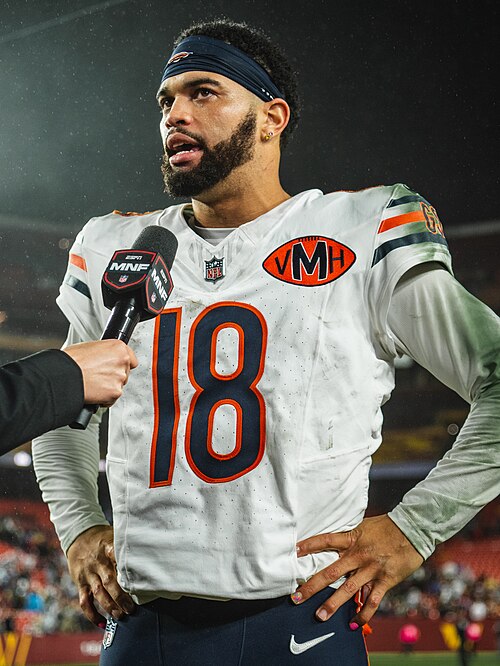
DJ Moore is gone. The Bears traded their most reliable target to Buffalo on March 11, leaving Caleb Williams without the veteran presence who caught 96 passes last season. Chicago's receiving corps now centers around two players with drastically different draft costs: Rome Odunze at ADP 22 and Luther Burden at ADP 121.
Chicago's receiving corps now centers around two players with drastically different draft costs: Rome Odunze at ADP 22 and Luther Burden.
Odunze is being drafted as Chicago's clear WR1 -- nearly 100 picks ahead of Burden.
The Target Vacuum Moore Left Behind Moore's departure removes 96 catches and 1,364 yards from Chicago's offense.
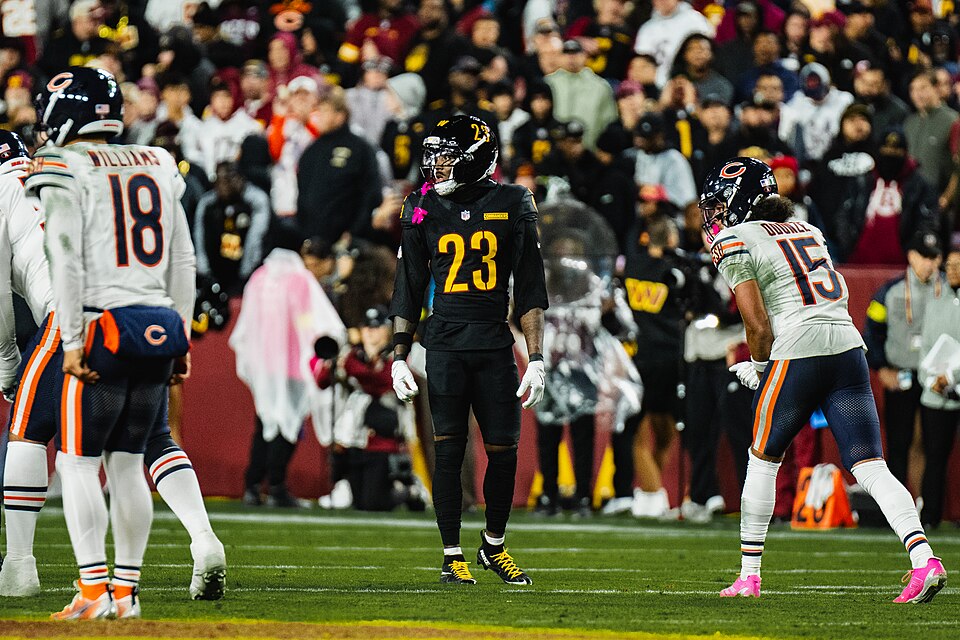
The market has decided. Odunze is being drafted as Chicago's clear WR1 -- nearly 100 picks ahead of Burden. But markets can be wrong, especially when evaluating young players whose roles might shift after a major roster change. Burden's rookie numbers suggest this gap is too wide, and Williams' target distribution after Moore's departure could surprise a lot of draft rooms this summer.
The Target Vacuum Moore Left Behind
Moore's departure removes 96 catches and 1,364 yards from Chicago's offense. Those targets have to land somewhere. The Bears did not replace him in free agency. They did not trade up in the draft for a proven veteran. The redistribution falls entirely on internal candidates.
Beyond Odunze and Burden, the depth chart shows Colston Loveland at tight end (ADP 155) and a collection of role players who are not being drafted in most leagues. This is not a crowded receiver room fighting for scraps. This is an established prospect and a potential sleeper competing for expanded roles in an offense that threw the ball 550 times last season.
Williams completed 66.5% of his passes as a rookie. His yards-per-attempt improved from 6.2 in September to 7.8 in December. The progression was real, and so was the connection he built with both Odunze and Burden during their first year together. Now one of those connections has to deepen while the other might expand beyond what the draft market expects.
Rome Odunze: The Anointed One
The market has spoken on Odunze. At ADP 22, he is being drafted as a locked-in WR2 with upside for weekly WR1 performances. The projection system supports this optimism, ranking him 10th among wide receivers with 151.6 PPR points and 8.92 points per game.
His rookie season provided the foundation for this confidence. Catching 54 passes for 762 yards while playing alongside Moore, Odunze showed he could produce despite not being the primary option. His 14.1 yards per catch demonstrated big-play ability, while his 77% catch rate reflected reliable hands in traffic.
What makes Odunze appealing is positional versatility. At 6'3" with precision route-running, he fits multiple receiver archetypes. He can work outside on comeback routes, in the slot on crossing patterns, or in the red zone on jump balls. That flexibility gives Williams options and gives Odunze paths to targets regardless of game script.
The confidence band on his projections reads "low," indicating variance in potential outcomes. But variance at ADP 22 means the difference between solid WR2 production and legitimate WR1 ceiling weeks. When you draft him, you are paying for the most likely scenario -- a featured role in an offense that should improve in year two.
Luther Burden: The Forgotten Producer
Here is where the market might have made a mistake. Burden at ADP 121 is priced as an afterthought -- a late-round dart throw with minimal expectations. But his rookie numbers tell a different story.
Burden caught 67 passes for 851 yards last season, actually outproducing Odunze in both volume and yardage despite similar target opportunity. His 12.7 yards per catch were respectable, and his route tree aligned closely with the intermediate patterns that Moore ran most effectively.
The projection system sees limited upside, placing Burden at WR57 with 76 PPR points and 4.47 points per game. Those numbers feel conservative for a player who already demonstrated chemistry with Williams on the routes that matter most for a young quarterback's development.
What the projections might miss is role expansion after Moore's departure. Burden's rookie production came while operating as the clear third option behind Moore and Odunze. If even half of Moore's 96 targets flow to Burden, his weekly floor jumps significantly. At ADP 121, the market has built in almost no expectation of expanded opportunity.
Burden also brings a different skill set than Odunze. Where Odunze wins with size and route precision, Burden creates separation through quickness and timing. His route tree from the slot and on underneath patterns matches exactly what Moore provided Williams as a security blanket. If Chicago wants to replace what they lost rather than reinvent their offense, Burden's profile fits better.
What the Target Math Says
Moore's 96 targets do not disappear. They redistribute somewhere, and basic mathematics says both Odunze and Burden benefit. The question is how much each player gains and whether their current ADPs reflect realistic target projections.
Odunze's ADP assumes he becomes the clear alpha with 100-plus targets. That outcome feels likely given his draft position, physical tools, and first-year production. The market has priced this scenario appropriately.
Burden's ADP assumes minimal growth from his rookie role. That assumption feels aggressive given Moore's departure. If Burden's targets increase from roughly 75 as a rookie to 90-100 as a sophomore, his late-round cost becomes a steal. The gap between his projected production and his actual opportunity could be wider than the system accounts for.
The 99-pick difference in their ADPs suggests the market sees a massive gap in their expected roles. But talent evaluation and opportunity allocation do not always align perfectly, especially when roster turnover creates unexpected openings.
The Opportunity Cost Calculation
Drafting Odunze at ADP 22 means passing on proven veterans in similar ADP ranges. You are betting on upside over established production, which makes sense if you believe in Williams' development and Chicago's offensive progression.
Drafting Burden at ADP 121 costs you almost nothing. At that price, you are choosing between him and players who might not see the field for weeks. The risk-reward calculation favors taking the shot on target expansion in a clear opportunity vacuum.
The smarter play might be recognizing that Moore's departure benefits both receivers, just in different ways. Odunze gets the alpha role and the red-zone targets. Burden gets the safety valve targets and the volume boost. Both can provide value, but Burden's cost allows for larger profit margins if his role grows.
The Verdict
Draft Odunze if you want the safe bet. His ADP reflects realistic expectations for a player who should see 100-plus targets as Williams' primary option. The projection system supports his cost, and his rookie production suggests he can handle expanded responsibility.
Draft Burden if you want the value bet. His ADP builds in minimal expectations, but Moore's departure creates clear opportunity for target growth. If Williams continues leaning on the intermediate routes where Burden operates, ADP 121 will look cheap by October.
The market decided this competition was over before it started. Odunze is the WR1, Burden is the afterthought. But 96 targets have to land somewhere, and opportunity often trumps draft capital when young quarterbacks develop their progressions.
Chicago's receiving corps is not as settled as the current ADPs suggest. One of these players will significantly outperform his price. The question is whether you want the certainty of the anointed option or the upside of the forgotten producer.