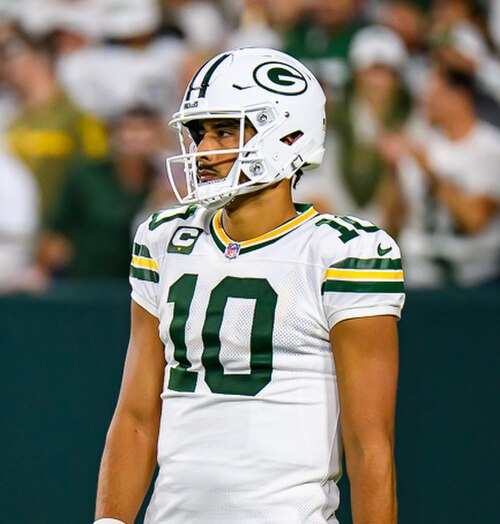
A traded receiver can clear a stat line without clearing a job. That is the Green Bay trap.
Green Bay still finished last season above a 56 percent pass rate overall and above a 56 percent neutral pass rate.
Across the broader sample, Reed averaged 4.4 targets with a 17.06 percent target share, and his late snap share climbed.
Late in the sample, his offense share jumped to 60 percent from 42.5 percent in the earlier tracked window.
Dontayvion Wicks was officially traded from Green Bay to Philadelphia on April 13, and fantasy drafters immediately did what fantasy drafters always do. They looked for the nearest wideout and called it a promotion. I do not think Jayden Reed got promoted. I think he got a louder headline.
Green Bay still finished last season above a 56 percent pass rate overall and above a 56 percent neutral pass rate. Matt LaFleur is still the head coach. Adam Stenavich is still the offensive coordinator. Jordan Love still has multiple viable answers in the same passing game. That is why this debate matters. The offense is worth buying. The clean No. 1 receiver story still is not.
State the debate cleanly
The pro-Reed case is easy to understand. One receiver left, the Packers still throw enough to matter, and Reed is the receiver most people want to believe can turn motion touches into a bigger featured role.
The problem is that Green Bay did not lose the parts of the room that actually make Reed hard to trust. Availability Watch is quiet on Reed, Christian Watson, Tucker Kraft, Matthew Golden, and Love, so there is no injury-created shortcut here. This is still a role question, not an emergency replacement story. Draft action: treat the Wicks trade like a reason to re-check the room, not a reason to declare it solved. Failure case: if Green Bay really does use camp to condense the target tree, caution will make you late.
The best case for Jayden Reed
Reed's argument starts with one real point: he did earn more playing time late.
Across the broader sample, Reed averaged 4.4 targets with a 17.06 percent target share, and his late snap share climbed. Late in the sample, his offense share jumped to 60 percent from 42.5 percent in the earlier tracked window. That matters because Reed is the easiest Green Bay receiver to imagine as the motion player, the slot answer, and the underneath space creator if LaFleur finally decides the room needs one traffic cop.
That is what changed after the trade. Wicks left, and Reed is the cleanest candidate to absorb the snaps that come from taking one receiver out of the rotation. Draft action: if you want to bet on Green Bay simplifying the receiver room, Reed is the right upside swing. Failure case: more snaps did not become more control last year. His target share fell to 15.06 percent over that same closing three-game window, which is a warning that involvement and command are not the same thing.
The best case against Reed
This is where the easy offseason story starts to wobble.
Watson still gives Green Bay a real vertical winner. Across the broader sample, he averaged 6.2 targets with a 22.95 percent target share and a 31.91 percent air-yards share. Kraft gave Love something even more important late in the year: an easy answer. Kraft averaged 5.8 targets and an 18.32 percent target share over his last five, then climbed to 7.33 targets and a 23.33 percent target share over his last three. That is not background noise. That is a quarterback showing you where he likes to go when the offense needs a completion.
Then there is Golden. Team rosters list him with one year of NFL experience, but his late usage matters more than the label. His offensive snap rate jumped from 26.33 percent in the earlier tracked window to 61.33 percent late in the sample, and his role trend flags show rising snap share and rising target share. Wicks leaving removed one body. It did not remove the downfield role Watson owns, the middle-of-the-field role Kraft already built, or the possibility that Golden keeps taking up more space. Draft action: draft Kraft first, treat Reed as the conditional receiver swing, and stop acting like the trade cleared the whole runway. Failure case: Watson's role can stay volatile, and Golden can still be more interesting than useful. If both of those break Reed's way, the post-trade case gets much easier.
What changes the answer
The answer changes when Green Bay shows us a real pecking order instead of letting the market invent one.
If summer usage says Reed is the receiver who never leaves the field, Watson is only stretching defenses, and Kraft's late target run cools off, then Reed becomes a much better bet than he is right now. If the room keeps looking the same, then the trade was mostly a headline boost for Reed and not a football rewrite for the offense. Draft action: wait for the role clue, not the transaction dopamine. Failure case: the market often moves before the evidence gets obvious, so patience can cost you the cheapest entry point.
Final lean
That trade opened a conversation. It did not hand Jayden Reed a crown.
Reed is still draftable, because the offense is still good enough and the late snap climb was real. I just do not think the trade solved the hard part of the Green Bay puzzle. Reed still needs the room to condense. Kraft does not. Watson still has a real field-stretching job. Golden still has late-growth signals. That is too much traffic for me to call Reed the automatic winner.
Kraft's current TE5 price at ADP 71 fits the football story better than the summer rush to crown Reed, because Kraft already closed last year as Love's easiest middle-of-the-field answer.
Draft verdict: start with Tucker Kraft if you want Packers passing exposure after the trade. Let Reed be the upside swing only when the price stays honest, and make Jordan Love come at a discount that admits this passing game is still more crowded than the headline wants you to believe.