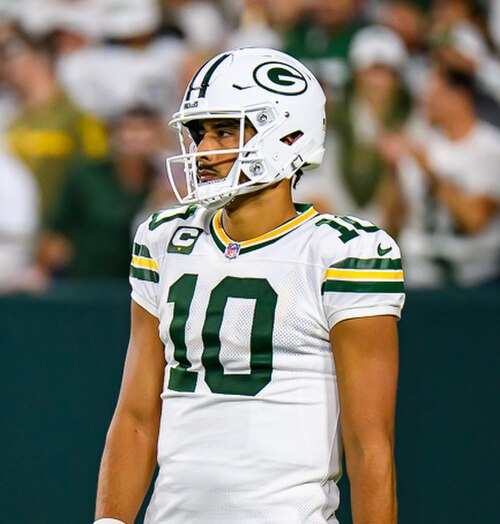
Dontayvion Wicks got traded to Philadelphia on April 13, and the lazy reaction is already loaded in the chamber. A Packers wide receiver left, so Jayden Reed must be the answer now. I do not buy it.
Green Bay still threw on 56.8 percent of its plays last season, stayed at a 56.89 percent neutral pass rate, and kept enough passing.
Across the broader sample, he averaged 4.4 targets, a 17.06 percent target share, and 9.7 PPR points.
In his closing five-game sample, he averaged 6.2 targets, a 22.95 percent target share, and a 31.91 percent air-yards share.
Green Bay still threw on 56.8 percent of its plays last season, stayed at a 56.89 percent neutral pass rate, and kept enough passing efficiency on the table to matter for fantasy. The offense is real. The clean receiver hierarchy is not. Vacated targets are the easiest lie in April, because somebody still has to win the useful ones.
If you want the short version, here it is: Reed is still draftable after the trade, but Tucker Kraft is still the cleaner Packers pass-game bet.
The bet being made
Drafting Reed after the Wicks trade is not really a talent argument. It is a consolidation argument.
You are betting that Green Bay finally stops spreading this passing game across too many viable answers. That is really the core question. Matt LaFleur is still the head coach. Adam Stenavich is still the offensive coordinator. Jordan Love is still quarterbacking the same offense. Wicks leaving changed one body in the room. It did not automatically change how the room behaves.
That matters because Green Bay still has Christian Watson's vertical role, Kraft's rising late-season involvement, and Matthew Golden now sitting in the same traffic pattern. If you draft Reed like the trade solved all of that by itself, you are paying for a verdict the offense has not actually handed you.
Condition 1: Reed has to turn late involvement into real control
What worked for Reed last year was that he stayed involved even when Green Bay never gave one wide receiver the whole room. Across the broader sample, he averaged 4.4 targets, a 17.06 percent target share, and 9.7 PPR points. His snap share also moved up late.
What did not show up was true command. Late in the sample, Reed's target share slipped to 15.06 percent, and his role flags turned up a falling target-share warning. That is the piece people keep trying to skip. Reed was still part of the offense. He just was not yet the player forcing the offense to run through him.
That is why the Wicks trade does not finish the argument. Availability Watch is quiet on Reed, Watson, Kraft, Golden, and Love, so there is no injury-created shortcut here. Reed still has to earn the targets that matter instead of inheriting the headline.
Draft action: treat Reed like a conditional swing, not like the Packers finally posted the answer key.
Failure case: if camp usage finally shows Green Bay treating Reed like the one receiver who can live in every situation, this caution will age badly fast.
Condition 2: Watson and Golden cannot keep the room stretched wide
Reed's biggest problem is not that Green Bay lacks pass volume. It is that the room still has other ways to win.
Watson is the obvious one. In his closing five-game sample, he averaged 6.2 targets, a 22.95 percent target share, and a 31.91 percent air-yards share. That is not a side role. It is the profile of the receiver still carrying the vertical stress job. Even in his last three, after the volume dipped a bit, the air-yards pull was still strong enough to keep this from becoming Reed's offense by default.
Then there is Golden. Team rosters list him with one year of NFL experience, and the late role trend matters more than the label. Golden averaged only 25.2 offensive snaps over his last five, but his snap rate jumped from 26.33 percent in the earlier tracked window to 61.33 percent late in the sample, with rising target-share and strong recent snap-share flags attached. He does not need to become the answer to hurt the Reed case. He only needs to be active enough to keep Green Bay from condensing around one wideout.
That is the real football problem in Green Bay. Reed is not chasing empty snaps. He is chasing a cleaner pecking order than Green Bay has shown us.
Draft action: if you want a Packers receiver, make the room give you a discount for the ambiguity.
Failure case: Watson's role can stay volatile, and Golden can still be a second-year receiver who needs more runway than the late snap jump suggests. If both of those things break Reed's way, the post-trade bump becomes more than summer noise.
Condition 3: Kraft has to stop being Love's easiest answer
This is the piece of the story the market keeps trying to talk around.
Kraft already gave Green Bay a passing-game answer that did not require the receiver room to settle. Across the broader sample, he averaged 5.8 targets and an 18.32 percent target share. Late in the sample, that climbed to 7.33 targets and a 23.33 percent target share. His trend flags are exactly what you want to see: surging volume, rising targets, rising target share, and rising fantasy output.
That matters in football terms because Kraft does not need the offense to declare a WR1 for him to matter. He can still be the quick-answer player, the chain-moving player, and the middle-of-the-field release valve while the wideouts keep trading turns. Reed needs the room to simplify. Kraft does not.
The Wicks trade does not change that part of the offense at all. If anything, it makes it easier for drafters to chase the shiny receiver promotion while ignoring the pass catcher who already showed Love where the easy money was late last season.
Draft action: if you want Packers passing exposure after the trade, draft Kraft before Reed.
Failure case: Kraft's snap share was not perfect late, and Green Bay can still spread the ball enough to make him more useful than dominant. Even then, the role logic is cleaner than asking Reed to solve three problems at once.
Final verdict
Reed can absolutely pay off after the Wicks trade. He just needs more to go right than the market wants to admit.
He needs his rising snaps to become real target control. He needs Watson's vertical pull to matter less. He needs Golden's growth to stay just interesting enough, not disruptive. And he needs Kraft to stop being the pass catcher Love already trusted when the season tightened up.
That is too many conditions for me to call Reed the automatic winner of this move.
So the sharper April rule is simple: do not auto-promote Jayden Reed because a teammate left. Draft Kraft first, treat Reed like the upside swing, and make Jordan Love come at the kind of price that admits this passing game is still more crowded than people want it to be.