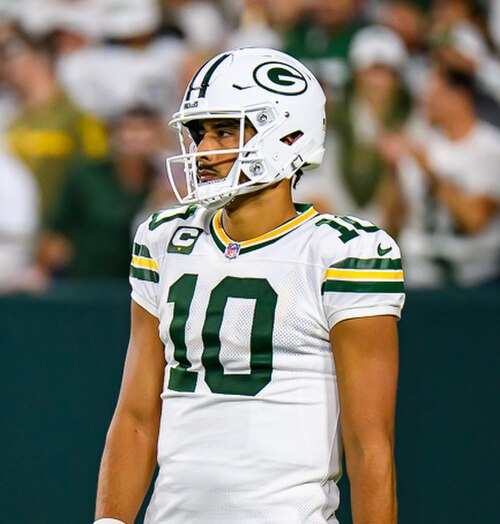
Green Bay can keep Jordan Love efficient without turning him into a weekly volume engine, and that is why he is not one fantasy pick. He is two different decisions wearing the same name.
At publication, Love sits at QB17 and No.
The Packers posted a 56.8 percent pass rate and a 51.2 percent early-down pass rate, with strong passing efficiency despite playing.
In the closing window, Watson averaged 6.2 targets and carried a 31.9 percent air-yards share.
In 1QB drafts, the move is patience. Wait for the room to push past him, or let someone else pay for a pocket-leaning quarterback in an offense that does not need to chase volume every week. In superflex, the answer changes: once the rushing quarterbacks are gone, Love becomes a conditional second-quarterback target because the format rewards stable access to competent passing games.
That split matters more than the rank. Love can be good for Green Bay and still be a mediocre one-starter bet if the price asks him to beat quarterbacks with cleaner rushing math. The edge is not deciding whether Love is good. The edge is knowing which league type actually pays you for his profile.
In 1QB, wait for the discount
The 1QB case starts with opportunity cost. If your league only starts one quarterback, you are usually hunting one of three things: elite rushing, weekly shootout volume, or a cheap pocket passer who lets you spend elsewhere. Love does not fit cleanly into the first two buckets, so the draft spot has to do more work.
What worked last season was efficiency, not a full offensive personality change. Down the stretch, Love averaged 25.8 attempts while still carrying positive passing EPA and positive completion percentage over expected. That is a useful football signal. Green Bay could keep the offense on schedule without asking him to throw 40 times just to survive.
The fantasy problem is that efficient and scarce are not the same thing. At publication, Love sits at QB17 and No. 95 overall in PPR while his ADP is 50. Do not turn that into the entire argument, but do not ignore what it says either. In a one-quarterback room, paying up for that profile means passing on players at positions where replacement value gets thin much faster.
Price discipline is the point. Love belongs on the 1QB list when the room lets him fall into a range where you are buying stability, not pretending he has the same weekly ceiling as the runners ahead of him. If the cost assumes a top-shelf fantasy separator, wait.
Superflex changes the job
Superflex is where Love becomes much easier to draft. The question is no longer whether he can beat every quarterback in raw ceiling. The question is whether he can protect your second quarterback slot from the weekly panic tier.
That is a real job. In superflex, a stable starter attached to a functional offense can be more valuable than a cheaper quarterback who needs chaos to matter. Love does not have to be a cheat code there. He has to give you playable weeks while your early-round backs, receivers, and tight ends do the heavier lifting.
Green Bay's passing profile supports that version of the bet. The Packers posted a 56.8 percent pass rate and a 51.2 percent early-down pass rate, with strong passing efficiency despite playing below expectation on pass rate. This was not a pure volume machine. It was a balanced offense that still created enough efficient passing to keep the quarterback conversation alive.
That is why the exposure point should come after the rushing tier. If the board has already taken the quarterbacks who bring bankable rushing volume, Love belongs in the next conversation. If he goes before that point, the pick starts asking a balanced Green Bay offense to create a fantasy edge it may not be built to create.
Green Bay's balance is both the reason and the ceiling
The Packers are not built like a team trying to win fantasy leagues through one passer piling up attempts. They are built to keep the offense multiple. The red-zone tendency was almost even between pass and run, and Josh Jacobs remains part of the scoring equation.
That is good football. It is also the cap on the Love bet.
When Green Bay is balanced, Love can run an efficient offense without dragging fantasy managers through ugly weeks. The same balance can also turn touchdowns into a shared pool. Jacobs can finish drives. Christian Watson can win downfield. Tucker Kraft can become the middle-field answer. Jayden Reed and Matthew Golden can keep the target tree from becoming too clean.
This is where the format split becomes practical instead of theoretical. In 1QB, that spread-out structure makes Love easier to pass on because managers can chase more concentrated weekly ceilings. In superflex, the same structure helps because it gives him more ways to stay playable.
The part that breaks the bet is not that Love becomes bad. It is that Green Bay stays efficient without becoming concentrated. That version can help the Packers win while leaving fantasy managers with a quarterback who is useful, but rarely decisive.
The cheaper way to buy Green Bay may be the pass catchers
If your reason for liking Love is really that you like the Packers passing environment, you do not always need to draft the quarterback. Watson and Kraft give you access to the same efficiency story without forcing the wrong format bet.
Watson is the spike-week path. His downfield role still matters because Love needs explosive plays to offset the smaller rushing cushion. In the closing window, Watson averaged 6.2 targets and carried a 31.9 percent air-yards share. That is not smooth weekly volume, but it is a real route to usable best-ball and bench-ceiling weeks.
Kraft is the stability swing. He gave Green Bay a middle-field answer, and his late-season role was stronger than a touchdown-only tight end profile. His closing window included 5.8 targets per game and an 83.4 percent snap share. That kind of usage gives him a path to matter even if the target tree does not fully consolidate.
There is still traffic. Reed is still on the roster, Golden is now part of the receiver mix, Jacobs keeps the offense from becoming pass-only, and Dontayvion Wicks leaving for Philadelphia does not magically turn this into a one-read passing game. The cheaper pieces work because they let you buy a specific lane, not because the whole room is solved.
The cleanest line is this: draft Love when the format pays you for quarterback stability; draft Watson or Kraft when the Love price is really just a tax on liking Green Bay.
The draft rule
Love is a format test, not a universal target.
In 1QB, wait. If he falls far enough, he can be a useful stability play. If he costs like a weekly edge, pass and use that pick where scarcity hits harder.
In superflex, be more willing to buy once the rushing tier is gone. Love gives you a path to a steady second starter tied to an efficient offense, and that matters in a format where the second quarterback slot can get ugly fast.
The mistake is drafting the name without drafting the league type. Draft Love as a superflex second starter after the rushing tier, not as a forced 1QB edge. If your format does not reward that stability, the better play is patience, or the cheaper Green Bay route through Watson and Kraft.