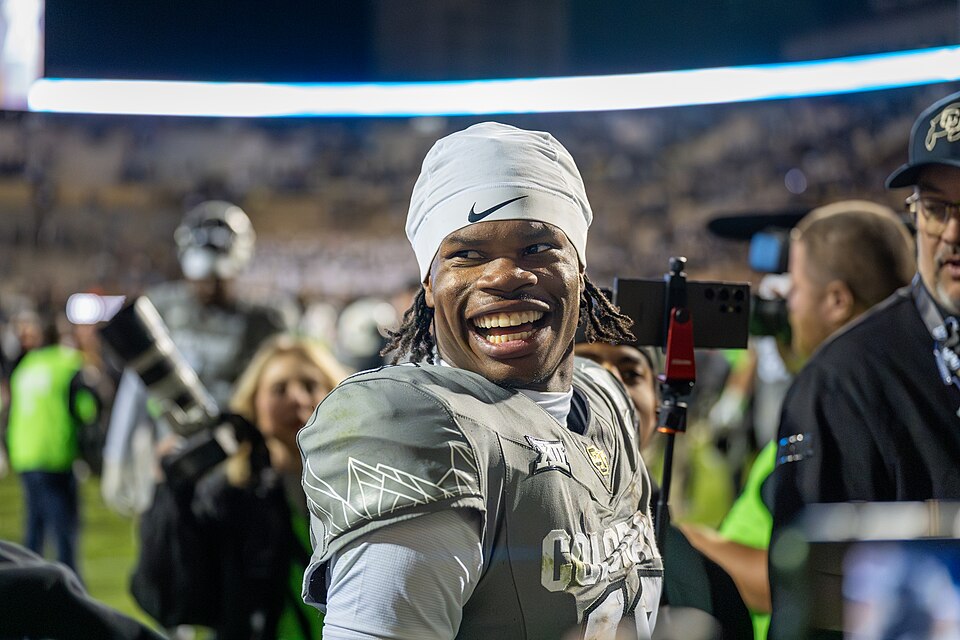
These two names keep getting thrown into the same bucket, and that is how draft rooms talk themselves into the wrong comparison. Tetairoa McMillan answers the question, "Who can help my starting lineup sooner?" Travis Hunter answers the question, "Who is the cheaper bench swing if my lineup already looks fine?"
Tetairoa McMillan already sits at WR13 in FFN's PPR ranks with an ADP of 37.
Bryce Young is QB24 in FFN's PPR ranks with an ADP of 98.
Travis Hunter sits at WR48 in FFN's PPR ranks with an ADP of 157.
Q: If I am on the clock first, who goes first?
McMillan goes first because Carolina is asking him to matter right away, and the current FFN room is lighter than Jacksonville's.
Tetairoa McMillan already sits at WR13 in FFN's PPR ranks with an ADP of 37. Jalen Coker is the only other Panthers wideout inside FFN's PPR top 200. That leaves McMillan with a cleaner path to real early targets instead of a summer-long fight just to become part of the weekly plan.
Draft action: take McMillan when you are filling a starting receiver spot and want a bet that can actually hit your lineup early.
What can break it is the offense. Bryce Young is QB24 in FFN's PPR ranks with an ADP of 98. If Carolina stays uneven, McMillan can still earn the targets and leave you wanting more from the weekly scoring.
Q: Why is Hunter still interesting if he goes later?
Hunter still works because Jacksonville already has structure.
Travis Hunter sits at WR48 in FFN's PPR ranks with an ADP of 157. That is the kind of price that makes sense for a bench swing, especially in a room that already has real target earners.
Brian Thomas already sits at WR12 in FFN's PPR ranks. Team rosters also show Parker Washington and Brenton Strange in the same fantasy tree. That sounds like traffic, and it is, but it also keeps Hunter in the right draft bucket. He is easier to like as an upside stash than as a player you need to start right away.
Draft action: take Hunter after your weekly starters are in place. He makes more sense as the bench receiver who can grow into your lineup than as the player you need to cover a shaky WR2 spot in September.
What can break it is that same crowd. If Brian Thomas keeps handling the lead job and Jacksonville spreads the rest of the work around, Hunter can spend the early part of the season looking more interesting than useful.
Q: So when does the answer swing from McMillan to Hunter?
The answer flips when your roster build changes and when the room starts charging you too much for McMillan's cleaner story.
McMillan is the earlier-volume play. Hunter is the cheaper swing. The ADP gap tells you that by itself: McMillan goes at 37, while Hunter goes at 157. That is a totally different draft problem, so do not draft them like they are solving the same need.
If you need points in your lineup sooner, pay for McMillan and live with Carolina risk. If your starters are already set and McMillan gets pushed past his sticker, waiting on Hunter makes more sense because he does not need immediate volume to return value.
Failure case: the wrong way to draft this pair is to flatten both players into one prospect argument. One is the starter bet. The other is the patience bet.
The closing lesson
Do not let draft buzz flatten these two into one argument. McMillan is the pick when you want targets now and can tolerate offense risk. Hunter is the pick when you want a cheaper swing with room to grow after the draft has already covered your weekly needs.
That is the cleaner way to separate them, and it usually leads to the better draft.