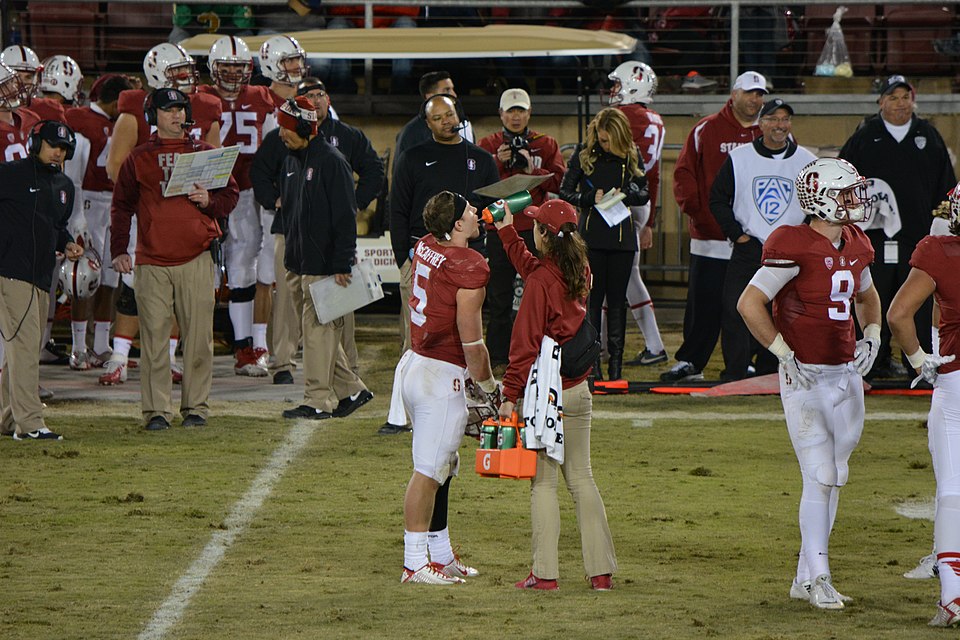
Pick 3 in your fantasy draft. The board is wide open. You type in "McCaffrey" and confirm. Did you just win your league or lose it?
Our projection system says Christian McCaffrey will score 152.8 points in standard scoring this season.
In full PPR, McCaffrey's projected output jumps to 212.8 points and 12.52 per game.
In half-PPR, he sits at 182.8 points and 10.75 per game.
Our projection system says Christian McCaffrey will score 152.8 points in standard scoring this season. That is 8.99 points per game. His projection rank: 89th overall. The market drafts him third. That 86-spot gap between where he is being drafted and where our model projects him is the largest disconnect in the top 100, and it is not close.
Reasonable people can look at the same player and reach opposite conclusions. So we built both cases.
The Case For McCaffrey
Kyle Shanahan's offense is the best landing spot for a running back in football. The scheme creates rushing lanes and receiving opportunities at a rate no other system matches. When McCaffrey is on the field in San Francisco, the volume is automatic.
The roster around him supports that volume everywhere it matters. Brock Purdy keeps defenses honest. Ricky Pearsall, Mike Evans, and Brandon Aiyuk stretch the field. George Kittle occupies linebackers underneath. That is an ecosystem designed to give the running back favorable boxes and open underneath targets on every drive.
Here is where format changes everything. In full PPR, McCaffrey's projected output jumps to 212.8 points and 12.52 per game. In half-PPR, he sits at 182.8 points and 10.75 per game. That is a 60-point swing from standard to PPR, driven entirely by his receiving work. Few running backs in the first round gain that much value from receptions. If your league rewards catches, McCaffrey's projection picture looks meaningfully different than the standard numbers suggest.
The bull case is straightforward: when McCaffrey plays a full season, the production follows. The projection system is pricing in risk, not talent. If the health holds, you got an RB1 at the cost of a pick you were spending on a running back anyway.
The Case Against McCaffrey
Start with the competition at his own draft price.
Saquon Barkley goes at ADP 7 and projects for 322.2 points and 18.95 per game with HIGH confidence. Jahmyr Gibbs goes at ADP 4 and projects for 298.1 points and 17.54 per game with MEDIUM confidence. Derrick Henry at ADP 5 hits 279.3 points and 16.43 per game with MEDIUM confidence. Ashton Jeanty at ADP 11 projects for 270 points and 15.88 per game, also MEDIUM confidence.
McCaffrey's 152.8 points at ADP 3 is not just below those players. It is less than half of what Barkley projects four picks later. The confidence band on McCaffrey is LOW, meaning the range of outcomes is wide and the floor scenarios are ugly.
Gibbs became an even safer bet this month. Detroit traded David Montgomery to Houston on March 11, removing the only meaningful competition for touches in that backfield. Gibbs now owns the workload at age 23 with a projection system that backs his volume. One pick separates him from McCaffrey. The projected point gap between them is 145.3 points in standard.
McCaffrey is 29 years old. Running backs at this stage face real regression curves, and the projection system weights that heavily. A LOW confidence band at 29 is not a neutral signal. It is the model telling you the downside scenarios carry serious weight.
The opportunity cost is what makes this pick genuinely dangerous. Every selection you pass on to take McCaffrey could be Gibbs, Barkley, Henry, or Jeanty. Those four all carry medium-to-high confidence bands. McCaffrey is the only top-5 ADP running back where the model flags downside as the primary scenario.
The Tier That Tells the Bigger Story
The top-10 RBs in standard scoring split into two distinct groups based on projection confidence:
Projection-backed: Gibbs (298.1 pts, medium), Barkley (322.2, high), Henry (279.3, medium), Jeanty (270, medium)
Name-driven: McCaffrey (152.8, low), Taylor (261.9, low), Cook (241.4, low), Achane (217.7, low), Jacobs (249.3, low), Williams (245.4, low)
Even inside the low-confidence group, McCaffrey stands apart. Taylor projects 261.9 points with the same low confidence rating. Cook projects 241.4. The model is not just uncertain about McCaffrey. It is actively bearish compared to every other first-round back.
The Verdict We Are Not Giving You
We are not telling you to draft or avoid McCaffrey. That depends on your scoring format, your league size, and how much risk you want concentrated in one pick.
What we will tell you: the data says this selection carries more downside than any other in the first round. If you take him, you are betting on health and pedigree against the projection system. If you pass, you are trusting the numbers over the name.