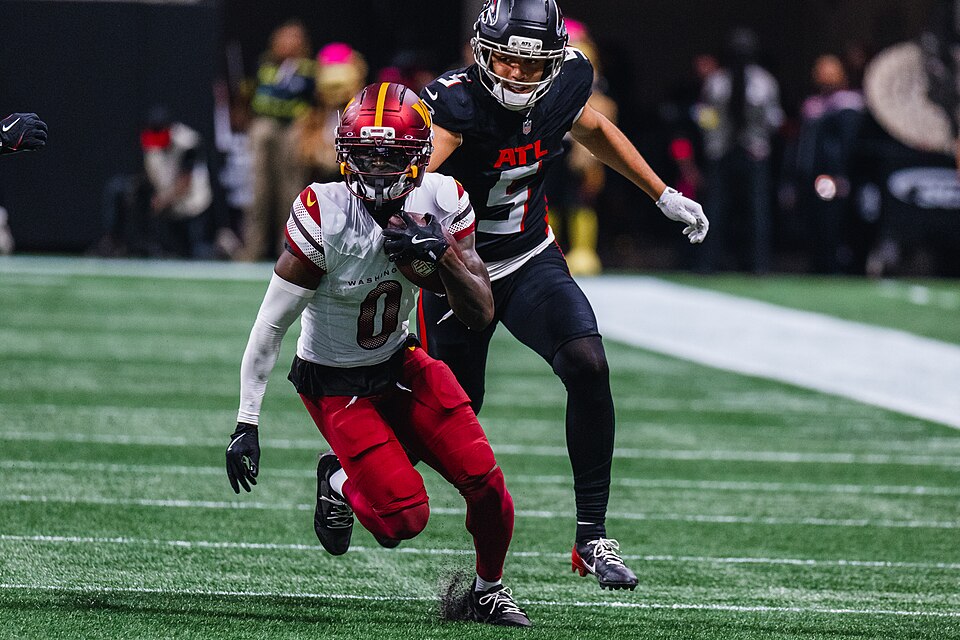
The first two picks write themselves. Bijan Robinson goes 1.01. Christian McCaffrey goes 1.02. You already knew that. But sitting at 1.03 in a 12-team PPR league, you're staring at a board that free agency rewired from top to bottom -- and the ripple effects don't stop until the middle rounds.
The 1.03 Fork: RB Safety or WR Ceiling At pick 3, you're choosing a lane.
Path A: Lock in Drake London Drake London sits at PPR ADP 12.
FFN projects him at 274.3 PPR points (16.14 PPG), which ranks 34th in our projection model against an ADP of 12.
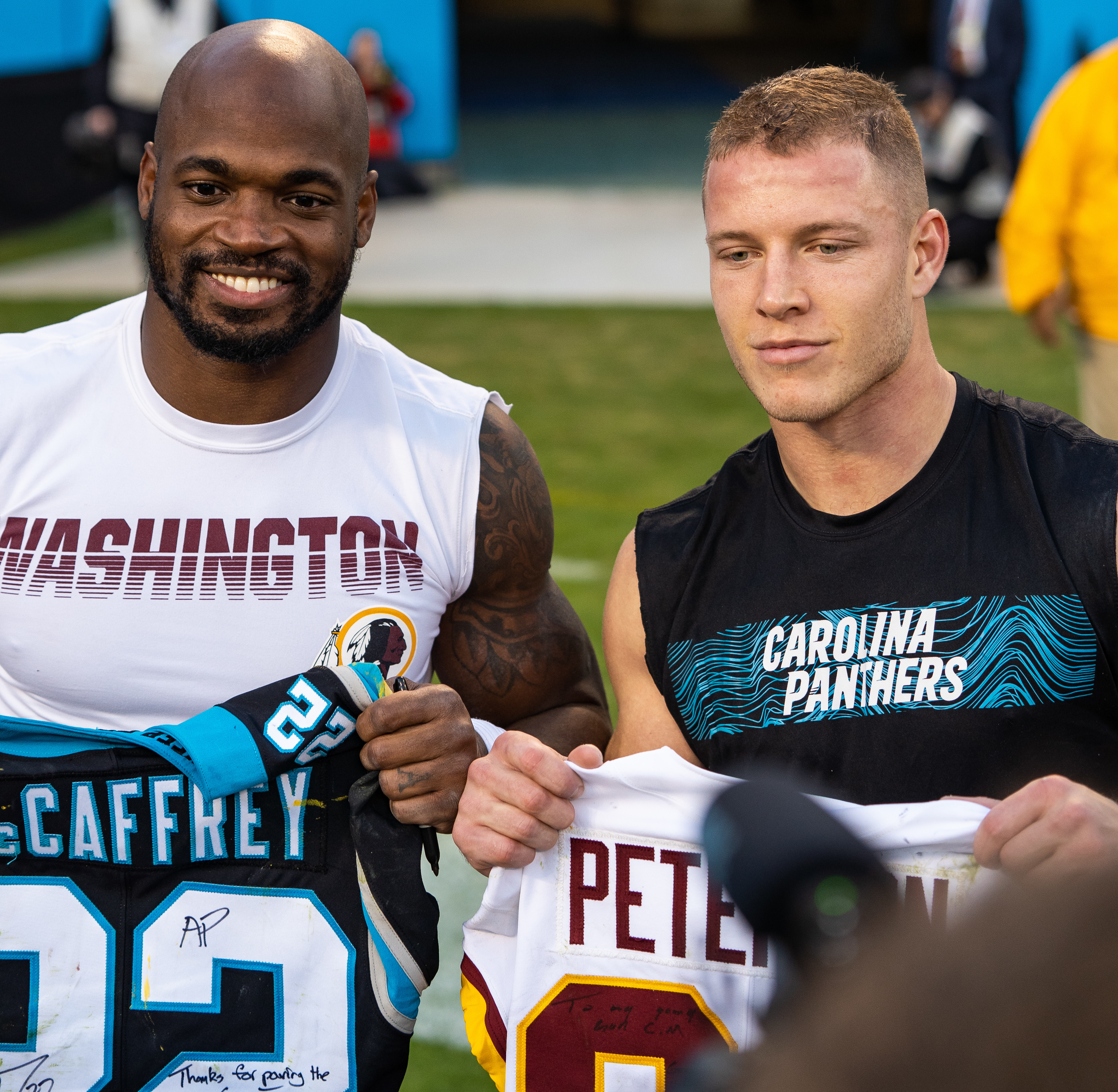
This isn't a generic "who should I draft" exercise. This is a decision tree built from FFN's projection engine, walking through the actual choices you'll face at each turn and what each path means for the rest of your roster.
The 1.03 Fork: RB Safety or WR Ceiling
At pick 3, you're choosing a lane. The running backs available here project for volume-based floors. The receivers offer positional scarcity at the top of the position. Both paths are defensible, but they build very different teams.
Path A: Lock in Drake London
Drake London sits at PPR ADP 12. FFN projects him at 274.3 PPR points (16.14 PPG), which ranks 34th in our projection model against an ADP of 12. That's a rare case where the market and the model mostly agree -- London's target volume in Atlanta is real.
The catch: Atlanta's quarterback situation is genuinely unsettled. Michael Penix is rehabbing the partially torn ACL that ended his 2025 season. Per our availability watch, his Week 1 timeline remains a rehab question mark. Meanwhile, Tua Tagovailoa signed this offseason at ADP 158 with a projection of 275 points. London's volume should be scheme-proof, but the efficiency ceiling depends entirely on who's throwing him the ball.
Path B: Go RB-RB early and let receivers come to you
The third running back off the board varies by league, but the ADP range between picks 15 and 29 is loaded with backs whose values shifted dramatically this offseason. That means your 2.22 pick (pick 22 in a 12-team snake) becomes critical.
The 2.22 Decision Point: Where Tampa Gets Interesting
Your second-round pick lands at the 22nd overall selection, and this is where Bucky Irving enters the conversation. Irving's PPR ADP sits at 29, but depending on your league's tendencies, he could easily land in the late second round.
Irving's format splits tell a story the overall rank doesn't.
- Standard: Rank 15, projected 196.3 points, 11.55 PPG
- Half-PPR: Rank 28, projected 219.8 points, 12.93 PPG
- PPR: Rank 29, projected 243.3 points, 14.31 PPG
That's a 14-spot drop from standard to PPR. For a running back, that gap is massive. Tampa's offense gave him the full workload after Rachaad White left for Washington, but his receiving role will determine whether he's a top-15 back or a borderline RB2 in full PPR. If the passing game stays centered on Emeka Egbuka, Chris Godwin, and Cade Otton, Irving's catch rate matters more than his carry volume.
At this same draft range, you're competing against Brian Thomas (PPR ADP 27, 273.4 projected points, 16.08 PPG) and Tetairoa McMillan (PPR ADP 28, 252 projected, 14.82 PPG). Both are high-ceiling receivers whose projection rank trails their ADP -- Thomas projects 35th overall, McMillan 49th. Irving projects 60th. The value gap favors the receivers unless you believe Irving's receiving role expands significantly under the new Tampa scheme.
Round 4-5: The San Francisco Target Puzzle
If you went RB-RB early, you're hunting receivers in rounds 4-5. This is where San Francisco's offseason gets complicated and creates opportunity.
The short version: Brandon Aiyuk is almost certainly gone. San Francisco has already behaved like a team planning for that outcome, which is why the 49ers went out and got Mike Evans.
Evans landed in San Francisco at ADP 48 (PPR rank 48). FFN projects him at 258 PPR points, 15.18 PPG, with a projection rank of 42nd overall. That's a player whose projection supports his draft cost. Evans has never posted fewer than 1,000 yards in a full healthy season across his career, and the model gives him medium confidence -- one of the few receivers in this range to earn that band.
One pick later, Ricky Pearsall sits at ADP 49. And this is where the data screams caution. Pearsall's projection: 153.5 PPR points, 9.03 PPG, with a projection rank of 141st overall. That is a 92-spot gap between where the market is drafting him and where the model says he should produce. In the entire top-50, Pearsall has the largest ADP-to-projection disconnect.
The market is pricing in a target share that hasn't materialized yet. Evans is the proven commodity. Pearsall is the bet. With Jauan Jennings at ADP 76 (235.9 projected PPR points, 13.88 PPG) and George Kittle at ADP 79 (236.1 projected, 13.89 PPG), San Francisco has too many credible mouths for Pearsall to justify a fourth-round pick. At back-to-back ADP spots, that Evans-over-Pearsall fork is worth understanding before you're on the clock.
Here's the sneaky play in this range: Jennings and Kittle project nearly identically, but the positional scarcity math is completely different. Jennings gives you a WR3 with WR2 upside at a fraction of the cost you'd pay for a comparable receiver. Kittle gives you the TE1 weekly ceiling in a wasteland of a position. Your roster construction should dictate which one you target.
The Round 8-9 Steal: Chris Godwin's Projection Gap
This is the part of the draft where preparation separates good teams from great ones.
Chris Godwin sits at PPR ADP 101. His projection: 301 PPR points, 17.71 PPG. His projection rank: 16th overall.
The model has Godwin projected as the 16th-best PPR asset in fantasy football, and the market is letting him fall to pick 101. That's an 85-spot value delta between projection rank and ADP. In the entire FFN data lake, very few players carry a wider gap between what the numbers say and where the market is drafting them.
The discount comes from injury history -- Godwin tore his ACL and the market is still applying a health haircut. But the projection model accounts for games-played expectations, and even with that factored in, 17.71 PPG in the rounds where the typical player projects between 10 and 12 points per game is a significant edge.
For context, look at who's going in the same neighborhood: Sam LaPorta at PPR ADP 91 projects 181.1 points (10.65 PPG) and Calvin Ridley at PPR ADP 92 projects 190.8 points (11.22 PPG). Godwin outprojects both by 100+ PPR points. Even if he misses three or four games, the per-game production justifies the pick.
How This Draft Builds
Here's what the full draft path looks like from pick 3, built from the ADP data:
- 1.03: Drake London (WR, ATL) -- target volume floor, QB uncertainty caps ceiling
- 2.22: Bucky Irving (RB, TB) -- format-dependent value, needs receiving work to hit PPR ceiling
- 3.27: Brian Thomas or Tetairoa McMillan if either slides (or pivot to Emeka Egbuka at ADP 39 -- Tampa's WR1 at 224 projected PPR points)
- 4.46: Mike Evans (WR, SF) -- proven production in a new home, medium confidence band
- 6-7 range: Jauan Jennings (SF, ADP 76) or George Kittle (SF, ADP 79) -- nearly identical projections, different positional scarcity plays
- 8-9 range: Chris Godwin (WR, TB) -- the biggest projection-to-ADP gap on the board
The Bottom Line
Pick 3 in PPR isn't just about who you take first. It's about understanding how Tampa's receiving corps repriced itself (Irving up, Godwin way down, Egbuka slotting in as WR1), how San Francisco's target puzzle creates a clear Evans-over-Pearsall signal in the data, and how Atlanta's QB situation adds variance to an otherwise elite Drake London profile.
The board looks different depending on your format. It looks different depending on whether Penix is healthy Week 1. And it looks different once you realize Godwin at ADP 101 might be the single biggest market inefficiency in 2026 drafts.
Build your team around the gaps the market hasn't closed yet. That's where leagues are won.