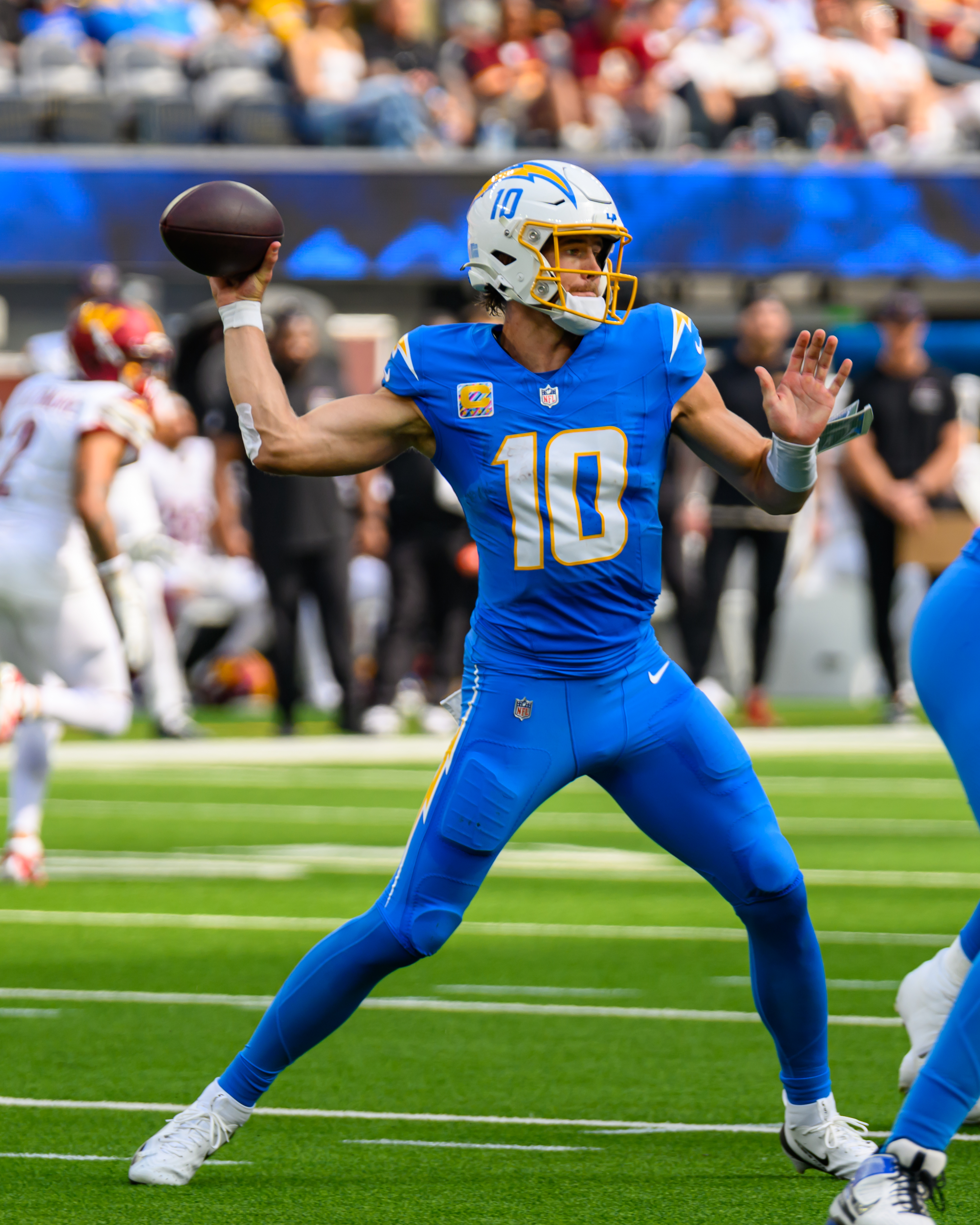
The Omarion Hampton argument is easy to understand. The price is the problem.
The Chargers passed on 59.54 percent of red-zone snaps, keeping Justin Herbert at the center of the offense.
In FFN's current PPR rankings, he sits RB19 and No.
55 overall, while the market is still pushing him at ADP 12.
Hampton can play. That part is not in dispute. What drafters are paying for now is the clean version of the Chargers backfield, and I do not think the football has caught up to that story yet.
Last year, Los Angeles did not behave like an offense begging to hide the quarterback and let one back run the whole show. The Chargers threw on 63.32 percent of their plays, stayed at 62.06 percent on neutral downs, and still passed on 59.54 percent of their red-zone snaps. Justin Herbert was still the center of the offense. Jim Harbaugh being on the sideline did not change that.
That is why Hampton feels expensive to me. In FFN's current PPR rankings, he sits RB19 and No. 55 overall, while the market is still pushing him at ADP 12. That price only works if the Chargers give him the touchdown funnel, the cleaner snap split, and the weekly control role that the offense still has not shown. You are not paying for talent alone. You are paying for the backfield to settle exactly the way fantasy managers want it to.
The room is drafting the ending and calling it research.
Bets I trust
I trust the Chargers to stay Herbert-led until the offense shows me something different
The easiest mistake in this conversation is acting like last year's Chargers were already some old-school, three-yards-and-a-cloud-of-dust team that accidentally let Herbert throw. They were not. They stayed pass-forward over the full season, stayed pass-forward in neutral situations, and even when they got into the red zone they still preferred the quarterback more than the backfield.
That matters because Hampton's current cost needs a very specific offensive rewrite. It needs Los Angeles to become meaningfully more run-committed without sacrificing scoring chances. It needs the staff to stop treating Herbert as the cleaner answer near the money area. And it needs one back to absorb the benefit of all of that.
Most draft rooms are treating that like a much smaller ask than it really is.
The pass-first shape matters even more when you look at how shaky the down-to-down efficiency could get. The Chargers averaged 3.53 sacks suffered per game last year. Their passing EPA average finished at minus-1.37, and the rushing EPA average sat at minus-0.37. This was not some polished machine waiting on a new featured runner to cash fantasy tickets. It was an offense that kept leaning on the quarterback because the offense kept asking for quarterback answers.
So when I hear the easy Hampton pitch, what I really hear is three assumptions stacked on top of each other. First, the run volume needs to rise. Second, the red-zone decision-making needs to tilt toward the backs. Third, Hampton needs to be the one who benefits most. Early picks get dangerous when they need that much cooperation.
Draft action: if you want Chargers exposure early, do not force the backfield story just because it sounds cleaner on paper than it looked on the field. Make the offense prove it wants to be different before you draft like the change already happened.
Failure case: Harbaugh can absolutely decide the offense needs to lean harder into the ground game this year, and if that happens the whole tone of this argument changes fast. I just want to see the offense become that before I pay for it.
I trust Hampton the player more than Hampton the job description people are buying
This is not an anti-Hampton talent piece. He gave drafters real reasons to be interested.
Across the broader sample, Hampton averaged 14 carries, 3.8 targets, and a 52.2 percent snap share. In his latest tracked game, that snap share even spiked to 81 percent with 14 carries and 8 targets. That is exactly the kind of closing stretch that gets a room excited, and honestly, it should. The player looks real.
But that is also where the draft argument gets sloppy.
A back playing a little more than half the snaps in a Herbert-led offense is an interesting growth bet. A back playing a little more than half the snaps at this kind of draft cost is a burden. He does not just need to be good. The role has to sharpen. The passing-down work has to stick. The money-area usage has to stop feeling shared. The backfield has to lose friction.
Fantasy managers keep skipping that part because talent is easier to talk about than job description. Hampton's role-trend window says the growth is real, but it also says the role still was not finished. Late in the sample, he averaged 15 carries and 3.67 targets, which is useful, but his snap rate in that same span was only 57.33 percent. Over the previous three, it was 59.33 percent. That is not full-control territory. It is still enough sharing that the price has to project a second jump.
And once you admit a second jump is required, the whole conversation changes. You are no longer drafting what Hampton already was. You are drafting what he still has to become.
Second-round backs should remove stress, not create a three-condition scavenger hunt.
My rule here is simple. If Hampton slides into a range where you are buying growth instead of certainty, I can understand the click. If he stays where the market has him now, the price is doing too much of the storytelling for me.
Failure case: sometimes the right answer really is to trust the talent before the whole league gets the proof. Hampton could absolutely take over by August and make this read feel too cautious. That is possible. It just is not the safest thing to assume with an early pick.
Bets I still do not trust
I do not trust the solved-backfield pitch while Kimani Vidal is still sitting there
The clean Hampton case wants Kimani Vidal to be background noise. I do not think that is honest to the actual usage we already saw.
Vidal's late-season trend turned ugly, and that absolutely matters. Late in the sample, he fell to 6.67 carries, 0.67 targets, and a 39 percent snap share, with the role-trend file flagging falling carries, falling snap share, and falling target share. That is real evidence against him.
But the reason he still matters is what happened right before that falloff.
In the earlier tracked window, Vidal averaged 14.67 carries, 2 targets, and a 65.67 percent snap share. That is not the footprint of a back who was never in the picture. It is the footprint of a back who already showed he can absorb meaningful work when the room shifts his way. Once a secondary back has put that kind of usage on the record, you cannot just wave him away because the ending got quieter.
The offseason also kept him alive. Vidal was officially re-signed by the Chargers on April 14. That does not prove a committee is coming, and it does not make Vidal the favorite. What it does do is keep the nuisance-work path very real. Hampton does not need Vidal to become a star for the price to get uncomfortable. Vidal only has to keep enough rotational work, passing-down snaps, or changeup touches to turn Hampton from a league-winning swing into a good player you drafted too aggressively.
This is where fantasy rooms get themselves in trouble. They think backup running backs only matter if they are good enough to steal the whole job. That is wrong. Sometimes they matter because they keep the starter from ever getting the clean version of the role that early drafters paid for.
My league rule: if somebody in your room wants Hampton at full freight, let them make the all-in bet. Vidal is the cheaper way to admit the backfield still has traffic.
Failure case: Vidal's late-year slide may have been the staff's real verdict on him. If that was the true read, then this obstacle shrinks fast. I just do not think the right answer is to pretend the obstacle is already gone.
I do not trust the touchdown shortcut either
A lot of the pro-Hampton case quietly assumes the Chargers will hand him the easiest fantasy math near the goal line because that is what people expect from a Harbaugh team. I think that skips the most important detail in the whole profile.
Last year, when Los Angeles got close, it still preferred to throw.
That single tendency matters because early-round running backs pay off by making the scoring math simple. If Hampton gets the first crack at normal-down work but Herbert keeps being the cleaner answer in scoring territory, then the path to smashing ADP gets narrow in a hurry. You stop drafting a bankable RB1 profile and start drafting an efficiency bet with extra conditions attached.
That is why the touchdown argument bothers me more than the talent debate. Talent can survive messy volume. Expensive fantasy backs usually cannot survive messy touchdown access.
There is also a practical draft-room angle here. Hampton is not being priced like a player who can miss on one part of the role and still be fine. He is being priced like the red-zone role, snap control, and overall touch shape are all ready to line up in his favor. That is an aggressive way to draft a backfield that still looks shared in the places that matter.
My rule here is simple: draft Hampton only if you are comfortable saying out loud that the touchdown role still has to be earned, not handed to him because the helmet and coach make the story sound neat.
Failure case: if the Chargers come out and start finishing drives through the backs instead of through Herbert, this read can die fast. Hampton drafters are really betting on that shift. I just think they are paying for it before the evidence gets there.
Final lesson for the draft room
I am not out on Omarion Hampton. I am out on the version of the story that says the Chargers already solved this for you.
The offense was still pass-forward last year. Herbert still gives this team its clearest identity. Hampton's own role was promising, but still looked more like a growing answer than a finished one. Vidal is still on the roster after an April re-signing, and he already showed enough prior usage to matter even if he never becomes a star.
That is enough for me to stay disciplined.
Draft the burden, not the buzz. If the burden says the offense has to change, the role has to clean up, and the touchdown split has to break one exact way, then the pick is too expensive unless the room gives you a discount.
If Hampton falls, I can listen. If he stays where the market has him, let somebody else draft the ending before the Chargers write the middle.