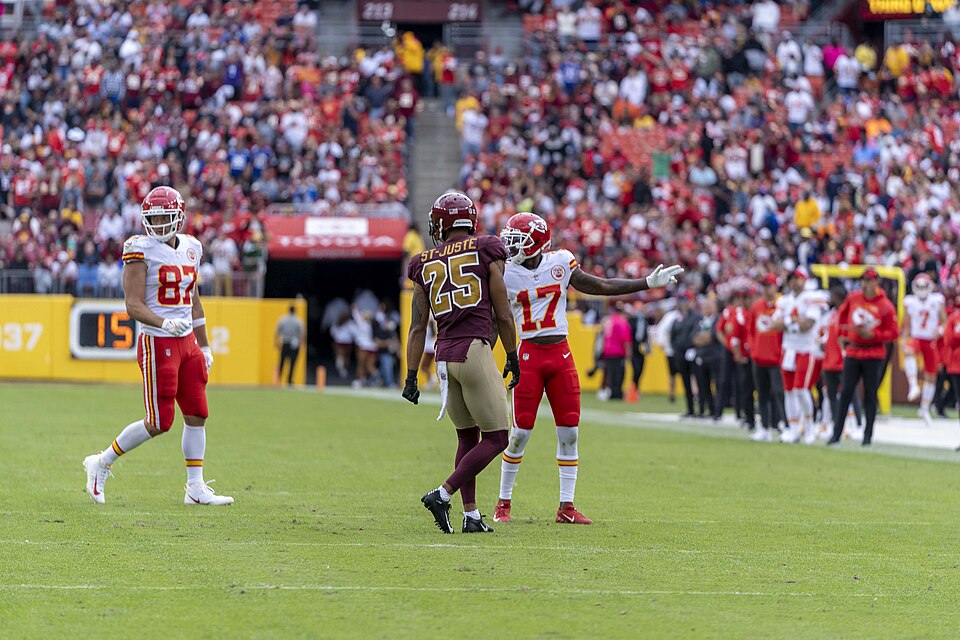
Kelce is no longer priced like the old cheat-code version, which is exactly why the draft case has reopened.
96 overall, with ADP 106 in FFN's current PPR rankings, and that discount only exists because drafters are pricing age and quarterback.
Across the broader tracked sample, Kelce still averaged 6.0 targets per game with a 23.1 percent target share, a 23.9 percent air-yards.
The Chiefs finished 2025 with a 66.9 percent pass rate, a 66.7 percent neutral pass rate, and a 61.4 percent red-zone pass rate.
This is not a vintage-Kelce pitch. Age 36 matters, and Mahomes' high-severity return window after ACL and LCL surgery matters too. But if you are going to fade an older tight end, fade the right thing. Call the explosion gone. Call the ceiling gone. Do not fade a role that still lived inside one of the most pass-heavy offenses in FFN's files.
The market finally pushed that too far. Kelce is TE8, No. 96 overall, with ADP 106 in FFN's current PPR rankings, and that discount only exists because drafters are pricing age and quarterback uncertainty at the same time. At that point you are not paying for the old cheat-code version. You are paying for a veteran tight end whose job survived longer than the room wants to admit.
What actually survived last year
The easiest way to get Kelce wrong is to talk about him like the whole profile collapsed. It did not.
Across the broader tracked sample, Kelce still averaged 6.0 targets per game with a 23.1 percent target share, a 23.9 percent air-yards share, and an 89 percent snap rate. It is not the profile of a player being phased out. It is the profile of a veteran who still matters in the middle of the offense, even if he is not winning the same way he did three years ago.
That matters because Kansas City never stopped leaning into the pass. The Chiefs finished 2025 with a 66.9 percent pass rate, a 66.7 percent neutral pass rate, and a 61.4 percent red-zone pass rate. Tight ends do not need to look young forever if the offense still keeps giving them high-value chances to matter. Kelce does not need to run away from safeties anymore. He needs to keep being the trusted answer when the play compresses and the quarterback wants the fast throw.
The football case is still simple. Kelce's game now is about role stability, timing, and quarterback trust. Those traits age better than pure burst, especially at a position where half the player pool is still trying to earn five dependable targets in a month.
Draft action: if you wait at tight end, Kelce belongs back on the shortlist as an intentional pick, not a panic pick.
Failure case: if the age cliff hits for real, you will feel it fast. Older tight ends do not usually give you a long warning siren.
Why the price finally makes sense
Earlier in the offseason, the Kelce conversation was annoying because the name still carried a tax. That tax is mostly gone now.
FFN's board is telling you exactly what kind of bet this is. Kelce is a buy because the cost finally matches the risk. Mahomes' rehab matters. Kansas City's decision to bring in Justin Fields on March 19 matters too, because it acknowledges the team needs insurance while Mahomes works back. That uncertainty is part of why the room has cooled so aggressively.
Good. That is when veteran bets start getting interesting.
If Mahomes is healthy enough to keep the offense functioning the way Kansas City usually wants it to function, Kelce does not need a throwback season to beat TE8 pricing. He just needs the same basic job to survive. A six-target tight end in this offense can still matter when the market prices him like a memory.
The cleanest way to say it is this: the room is no longer fading a superstar. It is fading a still-usable job.
That overreaction is worth buying.
The late-season usage told a more useful story than the panic did
The box scores did not scream league winner, and that is exactly why people stopped looking closely enough.
Kelce's tighter tracked sample came with 5.3 targets per game instead of the 6.7 he saw in the previous three, and his snap rate dipped from 93.3 percent to 85.3 percent. On the surface, that looks like the warning light. The more useful detail is underneath it. His target share actually held steady, ticking from 22.0 percent to 22.7 percent, and his air-yards share climbed from 21.8 percent to 25.9 percent.
That is not what a disappearing player looks like. That is what it looks like when a team starts managing the mileage on an older body without erasing the player's importance inside the passing game. Kansas City may not need Kelce to play like his younger self again, but the offense still kept asking him to be part of real answers when he was on the field.
I care about that distinction because draft rooms always overreact to the wrong piece of aging. They see the snap dip and assume the role is gone too. Sometimes the player is just becoming more situational while the offense still trusts him in the situations that matter.
That is the Kelce case in one sentence: the body needs more management now, but the offense still talks to him like a solution.
In the veteran rebound aisle, Kelce is cleaner than Mark Andrews
This is where the football part matters more than the name recognition.
Mark Andrews is still getting drafted ahead of where FFN wants him, and I get why. Drafters know the player, remember the touchdowns, and want to believe the bounce-back story will feel obvious in hindsight. The problem is that Baltimore gives him a much shakier weekly environment than Kansas City gives Kelce.
The Ravens finished 2025 at a 53.6 percent pass rate, a 53.7 percent neutral pass rate, and only a 45.2 percent red-zone pass rate. That is a very different ecosystem. Baltimore still solves a lot of football with the run game, and that makes life harder on a veteran tight end who already needs the volume to stay meaningful.
Andrews' own late-season role never gave you much comfort either. Across the broader tracked sample, he averaged 3.6 targets with an 18.6 percent target share and just a 50.6 percent snap rate. FFN's live PPR board has him at TE17, No. 134 overall, with an Avoid tag at ADP 96.
Here is the split I care about. Kelce's risk is mostly age. Andrews carries age risk too, but he also lives in the less pass-friendly offense with the weaker late-season usage.
Draft action: if you are taking one older tight end on purpose, Kelce is the better bet right now.
Failure case: if Mahomes' recovery drags and the Chiefs have to shrink the passing game more than expected, that edge narrows in a hurry.
This is a roster-construction bet, not a nostalgia bet
The way I would actually use Kelce matters here.
I do not want him as the centerpiece of some "veterans never die" draft plan. I want him for builds that spend early on running backs and wide receivers, let the tight-end room flatten out, then take the veteran attached to the offense that still gives the position real weekly oxygen. That is a very different bet than drafting an older player because you miss the old box scores.
Kelce makes sense when you want the position to stop being a headache without paying the premium tax. He still has enough role stability to give you usable weeks, and he still plays in an offense that throws enough in neutral situations and enough near the goal line to keep the position alive. That is often all you need once the elite names are gone.
The important thing is not to draft him like the old version is coming back. Draft him like a veteran solution for a roster that waited. If he gives you more than that, great. If you need him to be the old weekly cheat code, you are already asking the pick to do too much.
Aaron Jones is the reminder that not every veteran role discount is equal
Aaron Jones is useful here because he shows what a worse veteran bet looks like.
Jones finished with stronger workload momentum. Late in the tracked sample, he jumped to 17.0 carries per game from 9.7 in the previous three, and his snap rate rose from 49.3 percent to 62.3 percent. Minnesota also kept him around with a revised 2026 contract in March, so this is not a dead-player argument.
The problem is that the market is still charging you for the clean version of the story. Jones sits at RB35 and No. 128 overall in FFN's current PPR rankings, but the ADP is 85. That gap is there because his path still needs the backfield to stay friendly and the touchdown math to cooperate. The Vikings were not exactly a run-first scoring machine either. They threw on 61.7 percent of their plays, stayed near 59.4 percent in neutral situations, and passed on 66.9 percent of their red-zone snaps.
That is why Kelce is the better veteran-role bet. His case runs through target share in a pass-heavy offense where the price has already come down. Jones needs the market to keep paying for a workload story inside an offense that still prefers to score through the air.
Draft the veteran role that already fits the team, not the one that still needs the team to change shape for you.
What can actually kill the bet
There are real ways this can go sideways, and they are worth naming cleanly.
The obvious one is Mahomes. If the rehab drags longer than expected and Kansas City has to play a bigger chunk of the season without the version of the offense it wants, Kelce's volume floor gets shakier fast. The Justin Fields trade is part of that story. It gives the Chiefs cover at quarterback, but it also reminds you that the passing game is not completely out of the woods yet.
The other risk is that the snap management turns into real usage erosion. Kelce already showed a late drop from 93.3 percent snap rate in one three-game window to 85.3 percent in the next. That is survivable when the target share holds. It gets uglier if the team starts pulling back both at the same time.
That is why I keep coming back to price instead of romance. At ADP 106, you can absorb those risks if the role stays mostly intact. At old Kelce prices, you could not. The number matters because it gives you room to be honest about the downside and still click the name.
Draft verdict
The overreaction is not that Travis Kelce got old. Of course he got old. The overreaction is pretending Kansas City already treated him like it was over.
The Chiefs still live through the pass. Kelce still carried real target share late last year. The price finally bakes in the danger. That is enough to make him a real draft-week target again if your build waits at tight end.
Anyone chasing ceiling without risk should keep walking.
For builds that want the veteran bet where the role still exists and the price finally admits the risk, this is the one. Draft the job that survived, not a stale age-curve assumption.