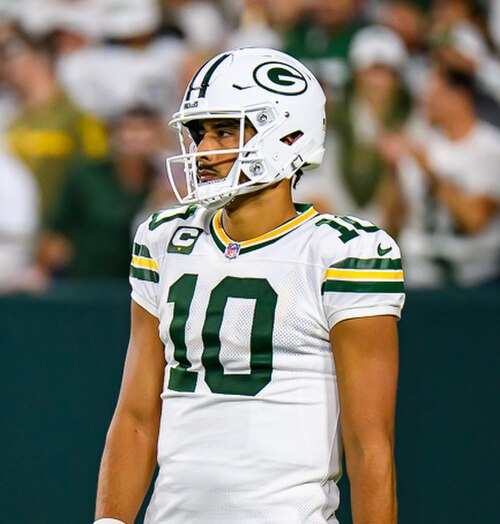
Draft day is almost here, and what to expect from Green Bay is one of the easiest mistakes to spot. One receiver leaves a crowded room, and suddenly managers start drafting like the whole puzzle solved itself overnight. Green Bay did not suddenly become simple. Dontayvion Wicks getting traded to Philadelphia on April 13 changed the Packers, but it did not turn this passing game into a one-name answer.
FFN's team tendency file shows Green Bay at a 56.89 percent neutral pass rate with a 44.32 percent motion rate.
At publication, Jordan Love sits at ADP 50 on FFN's board.
But if he slides into the later QB1 pocket, this is exactly the kind of offense worth buying through the quarterback first.
Here is the move by paragraph two, and it is exactly the kind of draft-day expectation worth getting right. If you want Packers passing exposure, start with Jordan Love after the early quarterback rush and let the second piece come to you later. Do not force Jayden Reed as the automatic winner of the Wicks trade. Do not draft like one subtraction made the pecking order clean. In this offense, the cleaner bet is the quarterback, then patience, then whichever pass catcher actually reaches a price that admits Green Bay still spreads work around.

The commissioner lesson is not to confuse change with clarity
This is the kind of draft-week spot that gets managers into trouble. Real news hits, and the next instinct is to turn it into a shortcut. Wicks leaving matters. It removes one branch from the receiver competition and makes Green Bay easier to read than it was a month ago. It does not make Green Bay easy.
That difference matters because the Packers still have the same offensive structure. Matt LaFleur is still calling the shots over a system that uses motion, moves pieces around, and keeps the whole passing game alive. FFN's team tendency file shows Green Bay at a 56.89 percent neutral pass rate with a 44.32 percent motion rate. This is still an offense worth drafting into. It is also not the kind of environment that owes you one obvious target hog the second a receiver leaves town.
Draft day punishes the manager who confuses one less mouth to feed with a solved offense.
Love is the cleanest way to buy the offense
What worked for Green Bay was never one receiver finally taking over every important route. What worked was that the quarterback stayed usable even while the target tree moved around. Jordan Love averaged 25.8 attempts, 5.8864 passing EPA, and 4.3982 passing CPOE in FFN's closing sample. That is not the profile of a quarterback who needs a perfect receiver hierarchy to matter.
That is why Love is the first bet here. He gives you exposure to the whole passing game without forcing you to solve the fight between Reed, Christian Watson, and Tucker Kraft before the draft board makes you. At publication, Jordan Love sits at ADP 50 on FFN's board. If he gets pushed so high that you are paying for certainty Green Bay has not earned, pass. But if he slides into the later QB1 pocket, this is exactly the kind of offense worth buying through the quarterback first.
It is also the better way to use uncertainty instead of fearing it. When the receiver room is still being debated, the quarterback lets you draft the production without overcommitting to one summer story.
Reed is still a bet, not a conclusion
Reed is the easiest name to promote after the trade, which is exactly why he is the easiest place to overreach. The case for him is not fake. Jayden Reed sat at a 17.06 percent target share on 4.4 targets per game in FFN's broader tracked window. He is involved. He can win in different parts of the formation. He still belongs in the Green Bay conversation.
The problem is what drafters tend to do with that information. They take a real role and inflate it into a guaranteed answer. Green Bay still has other ways to divide useful work. Christian Watson carried a 22.95 percent target share in the same broader tracked window, and Tucker Kraft sat at 18.32 percent while surging late in the season. Jayden Reed's FFN ADP is 119 at publication. The warning sign is obvious. Reed does not just need Wicks to leave. He needs the rest of the offense to stop asking for the ball.
So treat Reed like a conditional bet. If he cools off after a tier break, fine. If someone in your draft wants to pay the first post-trade premium, let them. The Packers did get clearer. They did not get simple.
The second Packers click should come from the board, not your ego
This is the part managers usually overplay. They draft the quarterback, then decide they have to prove they understood the room better than everyone else. That is how a good offense turns into two expensive guesses.
The better stack rule is simple. Draft Love if the value is there. Then wait for the pass catcher whose price actually admits Green Bay still has multiple live options. Tucker Kraft checks in at ADP 71 at publication, which keeps him in the part of the draft where the tight end pool can start thinning. If the position gets uncomfortable there, Kraft makes sense because his closing sample still showed usable volume and a real late-season rise. If Watson slides, that is your spike-play swing. If Reed is the one who finally comes down to a fairer range, then take the short-area volume bet there.
The point of this whole piece is simple. You do not need to leave your draft having solved the Packers. You need to leave it with the right amount of exposure to an offense that still throws enough to matter.
What could break the take
There is an obvious failure case. Green Bay can still stay balanced enough, and spread the targets widely enough, that Love gives you solid weeks without delivering the separation you wanted from the position. Reed can still end up priced correctly. Watson can still be the high-leverage answer when healthy. Kraft can still keep eating into the middle of the field. All of that is why the move is controlled exposure, not blind aggression.
But that same uncertainty is exactly why the quarterback is the cleaner bet than the receiver promotion. Love does not need one teammate to become the whole offense. He needs Green Bay to remain what it already looks like, a pass game with enough structure and enough weekly volume to stay fantasy relevant even when the distribution changes.
Final rule of thumb
The trade is real information. Treating it like Green Bay suddenly became a one-receiver offense is fake closure. If you want Packers passing exposure, draft Love first, then take the stack partner who actually falls into a reasonable range. That is the commissioner play. You are buying the offense, not marrying your draft to one guess.