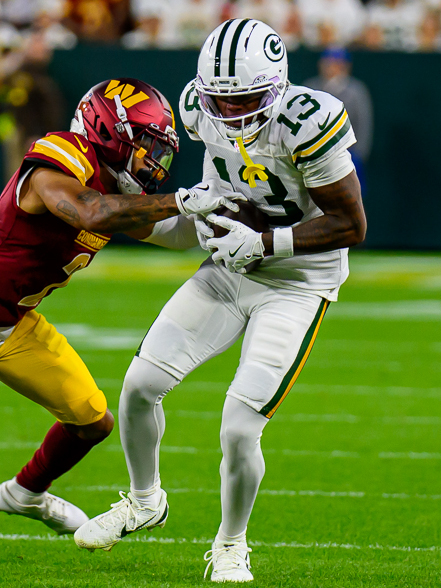
Green Bay did not lose one receiver and suddenly hand Tucker Kraft a clean breakout. That is too easy, and this offense is not built that way. The interesting part is narrower: Dontayvion Wicks leaving opens a target-lane question in an offense that already showed Kraft can matter when the passing game tilts toward him.
Down the stretch, his target share rose to 23.3%, and he averaged 7.3 targets in that closing sample.
FFN ranks Kraft TE4 in PPR with a medium confidence band, but the price remains context rather than the thesis.
That makes Kraft a conditional post-tier tight end target. Draft him after the obvious difference-makers if the price still leaves room for the role to grow. If he is being drafted like the Packers have already solved the target tree, wait. The bet is not "Kraft is good." The bet is that one lane stays open long enough to matter.
Condition one: Wicks' exit has to become real tight end work
The Wicks trade matters because it removes a receiver from a passing game that was already hard to flatten into one simple pecking order. FFN's transaction-impact feed lists Wicks as traded from Green Bay to Philadelphia on April 13, and that is the kind of offseason change that can quietly move a tight end from useful football player to useful fantasy bet.
What worked for Kraft was the shape of his late-season usage. Down the stretch, his target share rose to 23.3%, and he averaged 7.3 targets in that closing sample. At tight end, that is enough to change the weekly math. He does not need an alpha receiver workload. He needs Love to keep treating him like a regular answer inside the structure of the offense.
That is the first condition. Wicks' vacated work cannot just dissolve into a little more Christian Watson, a little more Jayden Reed, a little more Matthew Golden, and a handful of snaps nobody can use. If the Packers replace Wicks with a flatter rotation, Kraft becomes a cleaner football story than fantasy advantage.
If the missing receiver work makes the interior role easier to trust, Kraft becomes draftable after the first tight end tier. He is not a player to force. He is a player to target when the board still prices him like an unresolved role.
Condition two: Kraft has to win the useful part of the tight end room
The clean version of this bet ignores Luke Musgrave. The useful version does not.
Musgrave still shows up in the Green Bay role data, and his own recent profile is not empty. In the closing sample, he carried a 15.5% target share with a strong snap profile. That does not make him the better fantasy bet, but it does keep Kraft from becoming a simple volume claim.
Kraft's edge is that his late usage paired volume with actual passing-game weight. His closing sample included a 42.6% WOPR and 5.73 receiving EPA, which is a better signal than empty dump-off volume. The Packers were not just giving him a few low-value touches to keep the offense on schedule. They were getting efficient receiving work out of him.
That is why the role split matters more than the roster label. If Kraft keeps the routes Love trusts and Musgrave stays complementary, Kraft can beat the normal tight end churn. If Musgrave takes enough high-leverage work, Kraft turns back into a streamer-plus profile that needs the price to fall.
This is the line: draft Kraft when he falls after tight ends whose roles are already settled. Do not draft him over players whose teams have already made one tight end the weekly answer. The upside is role growth. The failure case is role sharing.
Condition three: Green Bay has to stay efficient without becoming pass-happy
Kraft does not need Green Bay to become a pass-only offense. That is not the bet, and it probably would not be the most honest read of this team anyway.
The Packers finished with a 56.8% pass rate and a 56.89% neutral pass rate, while their passing game produced a 6.988 passing EPA average. That is the useful middle ground. This offense can stay balanced and still create enough efficient throws for a tight end to matter.
Matt LaFleur and Adam Stenavich do not have to chase volume if the passing game keeps stressing defenses with motion, play-action, and personnel variety. The team tendency profile gives Green Bay a motion rate of 44.32%, with play-action and RPO usage also part of the structure. Kraft's case works best when those answers create easy access throws instead of asking him to win on raw target count alone.
The cap is built into the same argument. Josh Jacobs still anchors the run game. Watson can win vertically. Reed can win manufactured touches and slot work. Golden adds another receiver body. Green Bay can be efficient and still spread the ball too widely for Kraft to separate every week.
That is why the exposure point matters. The offense gives Kraft a path. The offense also gives him traffic.
The price test has to stay attached to the football case
At publication, Tucker Kraft has PPR ADP 71 and checks in as TE4 in PPR, with a medium confidence band. That is context, not the thesis. The thesis is the trade-created vacancy, Kraft's usage bump, Musgrave's threat, and the role path inside an efficient offense.
The model-lab salary view makes the same point in a different format. Kraft is flagged as dramatically cheaper than his rank profile in salary-style rooms, which is where the bet gets more attractive. If your room treats him like a throw-in tight end while the role data says he can grow, that is where exposure starts.
If your room already treats him like Green Bay has handed him the job, the edge gets thin. Tight end is where managers talk themselves into any athletic player with a quarterback and a path. Kraft has more than that, but the price still has to leave room for the path to become real.
A good Kraft pick is not a declaration that the Packers have a new alpha. It is a bet that the offense only needs one tight end lane to stay open.
Final verdict
Kraft is one of the better conditional tight end bets because the mechanism is real. A receiver vacancy changed the target math. Kraft already showed a late usage spike. Green Bay's passing game was efficient enough to support a usable tight end without turning into a pure volume offense.
The conditions are not small, though. Kraft has to keep the better receiving work, Musgrave has to avoid flattening the role, and the price has to leave profit if the target lane consolidates.
Draft Kraft after the obvious tight end tier when he is still priced like an unresolved Packers piece. Pass when he is priced like the answer is already locked in. Price discipline is the edge.
Put this article into your league context.
Open FantasyGPT with a question from this article prefilled, then add your roster and scoring details.