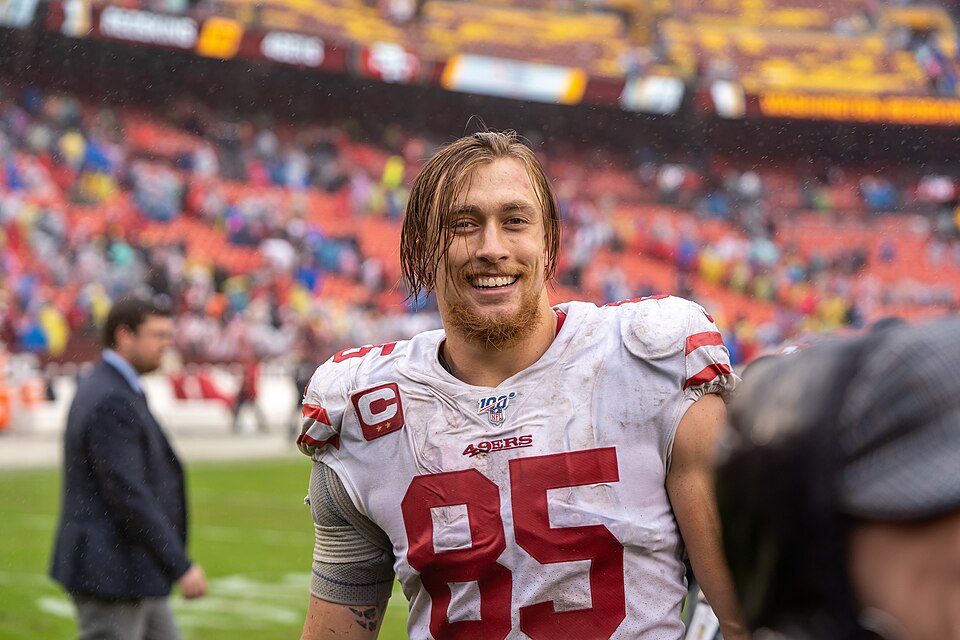
Brandon Aiyuk is done in San Francisco. The roster tells you everything you need to know -- Mike Evans signed, Jauan Jennings stayed, George Kittle and Christian McCaffrey are still running routes out of the backfield. That target tree has no room for a receiver the team has been trying to move since last summer.
Brandon Aiyuk • SF Roughly 100 targets from a player who owned a 24% target share in his last healthy season are about to redistribute.
In standard scoring, Evans projects 177 points (10.41 PPG) at ADP 53 with a projection rank of 64 and medium confidence.
In half-PPR, he projects 217.5 points (12.79 PPG) at ADP 54 with a high confidence band.
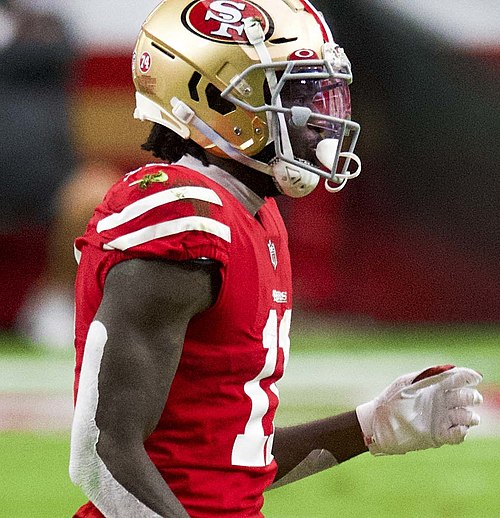
Roughly 100 targets from a player who owned a 24% target share in his last healthy season are about to redistribute across a completely rebuilt receiving corps. Every drafter needs to answer one question before August: who absorbs those targets, and is the market pricing the redistribution correctly?
The FFN projection data says the market has it wrong.
Evans Is the Pick. Pearsall Is the Fragile Bet.
Mike Evans and Ricky Pearsall sit one ADP spot apart in PPR leagues -- Evans at 48, Pearsall at 49. Same price on draft day. Completely different players in the projection model.
Evans projects for 258 PPR points at 15.18 per game, with a projection rank of 42nd overall. That is a six-spot value over his ADP -- not a screaming discount, but a player whose production backs up his price. He carries medium confidence, meaning the model trusts the range of outcomes. Twelve NFL seasons, 12 consecutive 1,000-yard campaigns. Age 32 entering year 13, and Shanahan's layered route concepts reward precise route runners -- which is exactly what Evans has been his entire career.
The format breakdown reinforces the case. In standard scoring, Evans projects 177 points (10.41 PPG) at ADP 53 with a projection rank of 64 and medium confidence. In half-PPR, he projects 217.5 points (12.79 PPG) at ADP 54 with a high confidence band. Across all three formats, Evans is a safe investment.
Pearsall projects for 153.5 PPR points at 9.03 per game -- a projection rank of 141st overall. Drafted at 49, producing like a player who belongs at 141. That 92-spot gap is the largest ADP-to-projection disconnect among any player in the top 50 of the FFN data lake. Standard scoring makes it worse: 102.5 projected points at ADP 54 with a projection rank of 154 and a low confidence band. Half-PPR lands at 128 points (7.53 PPG) at ADP 55, projection rank 145. The model does not trust Pearsall in any format.
Pearsall is 25 years old, entering his third season, and steps into the WR2 role opposite Evans now that Aiyuk's exit ramp is live. The talent is real. But his price assumes a target share he has not earned, and the projection model refuses to pay for potential when proven production is sitting right next to him on the draft board.
Draft Evans. Fade Pearsall at this ADP.
Jennings and Kittle: The Statistical Twins Nobody Saw Coming
Look at these two lines of data and tell me which player is which.
Player A: 235.9 projected PPR points, 13.88 PPG, projection rank 69. Player B: 236.1 projected PPR points, 13.89 PPG, projection rank 68. Three ADP spots apart. Season-long difference of 0.2 fantasy points. That is statistical noise.
Player A is Jauan Jennings at PPR ADP 76. Player B is George Kittle at ADP 79. Both carry medium confidence. The model sees them as the same player in terms of raw production.
The difference is positional scarcity. Kittle is the TE4 in ADP, and tight end production falls off a cliff after the top tier. Jennings is WR41, swimming in a receiver pool deep enough that comparable weekly output exists later in drafts. Need a tight end? Kittle is the move. Want exposure to the San Francisco passing game without paying Evans' price or gambling on Pearsall? Jennings is the pick the market is underpricing.
Jennings is 28 years old, entering his seventh NFL season, and the model treats him as a legitimate WR3 with WR2 upside in PPR formats. When you shift to half-PPR, the gap between these two widens slightly -- Kittle projects 196.6 points (11.56 PPG) at ADP 64, while Jennings drops to 192.9 points (11.35 PPG) at ADP 89. Standard scoring separates them further: Kittle at 157.1 (9.24 PPG, high confidence) versus Jennings at 149.9 (8.82 PPG, medium confidence). In non-PPR formats, Kittle is clearly the better play because receptions stop carrying extra weight.
When Aiyuk's targets scatter, Jennings is positioned to absorb the short-to-intermediate routes Shanahan uses to manufacture yards after the catch -- the same route tree that turned Deebo Samuel into a fantasy WR1 in this system. Jennings does not need to become Deebo. He needs 80 catches converting slot opportunities into consistent PPR production, and the model says he is already on pace for exactly that.
The Purdy Discount
Every fantasy manager has a story about the quarterback they drafted too early. Brock Purdy is the opposite problem -- a quarterback nobody is drafting early enough.
PPR ADP 112. Projected points: 300.58. Per-game average: 17.68. Projection rank: 17th overall. That is a 95-spot gap between where the market drafts him and where the model says he produces. Only a handful of players in the entire system carry a wider disconnect.
The discount exists because Purdy carries a low confidence band. New weapons, a reshuffled target distribution, and uncertainty about how efficiency numbers translate in the Evans era create a wider outcome range than the model is comfortable narrowing down. But look at the supporting cast: McCaffrey, Evans, Kittle, Jennings. The floor of that group is higher than the ceiling of most quarterback situations in football.
At ADP 112, Purdy costs you a 10th-round pick in 12-team leagues. He is 26 years old, entering his fifth season. The model slots him as QB17 -- technically a QB2 in 12-team formats, but his 17.68 PPG per-game rate rivals weekly QB1 production. The total-season ranking gets pushed down by the confidence band capping his ceiling, not by the per-game output. In standard scoring, Purdy's projection rank climbs to 10th overall, which tells you the model sees top-10 production potential when he is on the field.
The confidence band says caution. The projection gap says value. At a 10th-round price, you do not need certainty. You need upside. Purdy has it.
Aiyuk and Kirk: Dead Money on Your Roster
Brandon Aiyuk at PPR ADP 134 projects 165.6 points. Christian Kirk at ADP 120 projects 165 points. Nearly identical output from two players fighting over scraps in a passing game that feeds four mouths before theirs.
Neither is worth a roster spot at their current ADP in competitive leagues. Aiyuk carries medium confidence, which feels generous for a player who is unlikely to suit up for San Francisco this season. Kirk at medium confidence with 9.71 PPG is a bench receiver you are drafting in the 10th round -- a WR5 in a 12-team league with no clear path to weekly relevance.
Standard scoring drops both even further: Aiyuk at 102.6 points (6.04 PPG, ADP 140) and Kirk at 104 points (6.12 PPG, ADP 139). In half-PPR, Aiyuk falls to 134.1 points at ADP 155 with a low confidence band, while Kirk manages 134.5 points at ADP 149 with medium confidence. No format rescues these two.
Both are roster cloggers in a target ecosystem already claimed by Evans, Jennings, Kittle, and McCaffrey. Spend those picks elsewhere.
How to Draft the 49ers Target Vacuum
The priority order is clear.
Evans (PPR ADP 48) -- The safest receiver in this passing game. Production matches price, confidence is medium across PPR and standard (high in half-PPR), and 12 consecutive 1,000-yard seasons is not a data point you bet against.
Kittle (PPR ADP 79) -- The tight end play when you want positional scarcity advantage. Nearly identical PPR production to Jennings, but the TE landscape makes 13.89 PPG significantly more valuable at his position. Becomes the clear winner over Jennings in standard formats.
Jennings (PPR ADP 76) -- The value play when you need WR depth with upside. Seven spots of projection value over his ADP and the target profile to absorb Aiyuk's vacated intermediate routes.
Purdy (PPR ADP 112) -- The late-round quarterback play if the confidence band does not scare you. A projected QB17 at a 10th-round price with the best supporting cast of any quarterback going outside the top 100.
Pearsall (PPR ADP 49) -- The trap. A 92-spot projection gap is not a buying opportunity. It is a warning.
San Francisco's target vacuum will create real fantasy value this season. The data tells you exactly where that value lands. Trust the projections, not the hype.