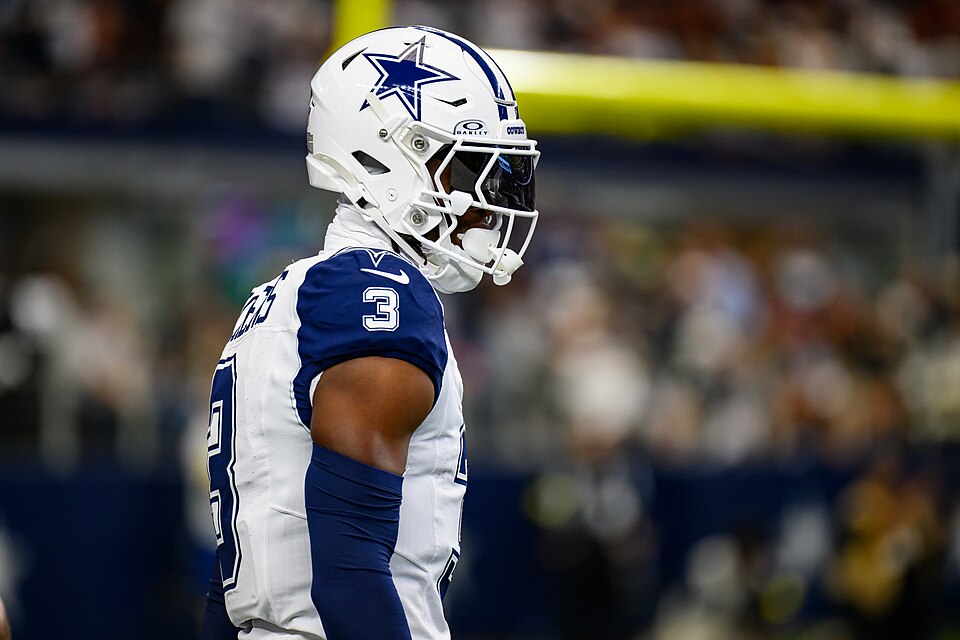
George Pickens is draftable in Dallas, but he should not be one of your first auction statements. The franchise tag keeps him attached to Dak Prescott and a pass-friendly offense. It does not make him the same kind of weekly certainty as CeeDee Lamb.
In the wider late-season role window, he averaged 6.4 targets and 10.94 PPR points.
At publication, the PPR board has Lamb as a high-confidence WR6 and Pickens as a medium-confidence WR9 with low projection confidence.
His late workload was thin, with 2.0 targets and a 26.8% offense snap rate across the wider late window.
Here is the usable answer by paragraph two: bid on Pickens only after the solved wide receiver tier is gone, and only if the price leaves room for uneven weeks. If your league treats the tag like a target-share guarantee, pass and let someone else buy the headline.
The tag changes the commitment, not the target tree
Auction leagues punish managers who confuse team commitment with fantasy certainty. A tag, a contract, or a familiar helmet can make a player feel safer than his weekly role actually is. Commissioners see that mistake every summer: one loud piece of roster news turns into a tax at the table.
Dallas gave Pickens a real commitment signal. The transaction file has the Cowboys using the franchise tag on him on Feb. 27, which kept him from reaching free agency and tied him back to Prescott. That matters. It says Dallas wanted the player in this passing game.
It still does not answer the fantasy question. Pickens is sharing the offense with Lamb, Jake Ferguson, Javonte Williams, and now a deeper receiver room that includes Marquez Valdes-Scantling and Tyler Johnson. That is not a reason to cross him off. It is a reason to stop pricing him like the target order has already been solved for you.
The tag bought Dallas control; it did not buy your fantasy team target control.
Pickens has a real role, just not a blank-check role
The pro-Pickens case starts with actual football. In the wider late-season role window, he averaged 6.4 targets and 10.94 PPR points. For a receiver who can win downfield and outside the easy underneath lanes, that is enough usage to matter.
The closing sample is why the bid needs discipline. Pickens still produced there, averaging 13.23 PPR points, but the role file also shows targets, snap share, and target share sliding from the previous window. That profile can look great in a highlight reel and still frustrate you if you paid for a clean weekly floor.
So the case is not "Pickens is bad." It is almost the opposite. He is good enough to tempt the aggressive bid, and Dallas is good enough to make the argument feel comfortable. The problem is that the weekly job still has to earn its way through Lamb's gravity and the rest of the offense.
If you draft Pickens, you are buying a talented receiver with spike-week ability in a strong passing environment. You are not buying the first read by default.
Lamb is the price check
Lamb is not the villain in this article. He is the calibration point. At publication, the PPR board has Lamb as a high-confidence WR6 and Pickens as a medium-confidence WR9 with low projection confidence. The exact ranks can move, but the shape of the decision is useful: one Dallas wideout carries the cleaner confidence profile, and the other needs a discount for volatility.
That matters more in auction than in a normal snake draft. In a snake draft, you can talk yourself into the pocket of the board where Pickens lands. In an auction, you have to decide in real time whether every extra dollar is still buying role value or just buying a name that feels safe.
The best Pickens bid should feel a little boring. You wait for the reliable target earners to set the market, then you price Pickens as the next kind of bet: good offense, strong talent, less control. If the bidding skips that middle step and jumps straight to certainty, the edge is gone.
That is not a fade. It is a price rule.
Dallas gives him oxygen
The reason to stay interested is the Dallas environment. The 2025 tendency file had the Cowboys at a 63.2% pass rate with a 59.7% neutral pass rate. That is real oxygen for more than one fantasy piece, especially with Prescott still listed as the quarterback.
The offense also had positive passing EPA on average in that team set, which matters because Pickens is not living on empty volume. He needs routes that create real downfield chances, not six low-value throws that make a box score look safer than the role feels.
Brian Schottenheimer and Klayton Adams give Dallas continuity in the broad offensive structure, but continuity is not the same as target clarity. A pass-heavy team can still squeeze a secondary receiver if the first read, tight end answers, backfield targets, and weekly game plan all take their turn.
The practical auction note is roster fit. Pickens can be part of a ceiling build, especially if your first receivers already give you weekly catch stability. He is a worse fit if you are trying to make him the stable piece who lets the rest of your roster swing.
Name value is not role value
Hopkins' role file backs up the warning. His late workload was thin, with 2.0 targets and a 26.8% offense snap rate across the wider late window. The model signal mattered because the football role underneath it was not sturdy enough for the name tax.
Pickens is in a better setup than that. Dallas is a stronger passing environment, and the tag is a cleaner team-commitment signal. But the lesson still travels: do not let a recognizable receiver profile make you pay for a role that still has to declare itself every week.
A good auction manager separates the headline from the job.
The final auction rule
Put Pickens below the solved wide receiver tier before the auction starts. Write the number down if you have to. If he lands under it, he fits as a Dallas role bet with real ceiling. If he pushes past it, you are no longer buying the player. You are buying certainty he has not fully earned.
The affirmative path is clear. Draft him when your roster already has stability, when the price reflects a volatile second lane, and when you can live with the weeks where the target tree runs through someone else. That is where Pickens makes sense.
Pass when the bid assumes Dallas tagged a target hog instead of retaining a talented receiver in a crowded offense. What breaks the take is Dallas funneling enough designed vertical work to Pickens that Lamb no longer owns the only reliable weekly path, but that is a summer usage signal to confirm, not a price to prepay.
Draft Pickens as the discounted Dallas ceiling piece. Pass at the certainty price. The tag matters, but the role still has to win.